|
|
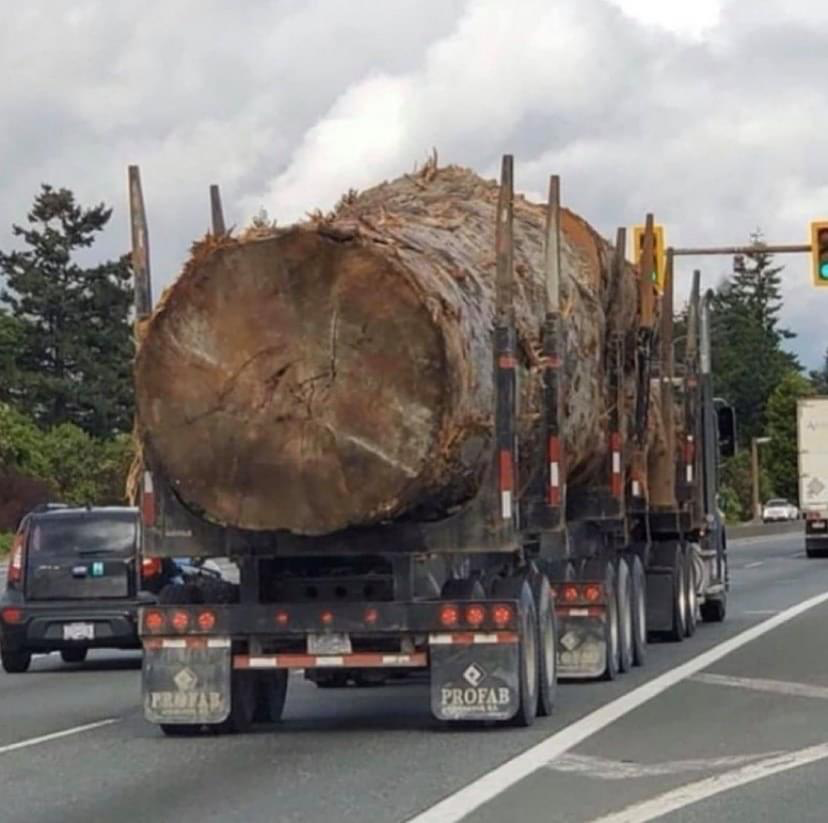 (image by Lorna Beecroft of Nanaimo, BC) The above image of an ancient spruce being hauled up the Vancouver Island Highway has gone viral and I can say in my years of driving up and down that same highway, I have seen many such obscene sights. These last old-growth conifers, the remnants of a unique temperate rainforest ecosystem, are being logged into oblivion despite a massive outcry led by environmentalists and First Nations communities. Sadly, the battle has been mostly lost outside a scant few officially protected zones so that British Columbia can continue using its ‘supernatural’ brand. As I write this, a huge and expensive police operation is underway at Fairy Creek , with helicopters and special SWAT teams being deployed to dislodge the hundreds of protesters putting their bodies on the line defending the last unprotected old-growth watershed on southern Vancouver Island. There have been dozens of arrests, suppression of media and acts of police violence.
So far, so typical. This spectacle has happened many times before, most notably during the massive Clayoquot protests in the 1990’s. Yet the zeal with which this supposedly left-of-center provincial government has propped up a clearly unsustainable industry, hell-bent on liquidating the remainder of what everyone agrees is a disappearing resource* isn’t just about the commercial value of old-growth trees’ market value, though this is an undeniable factor, as their price, like that of other endangered commodities like rhinoceros horn or elephant ivory goes up in proportion to their scarcity. There is something else happening here though – a less obvious and more sinister program by government and industry to change the very way we think of what a forest actually is.
*According to a recent study:
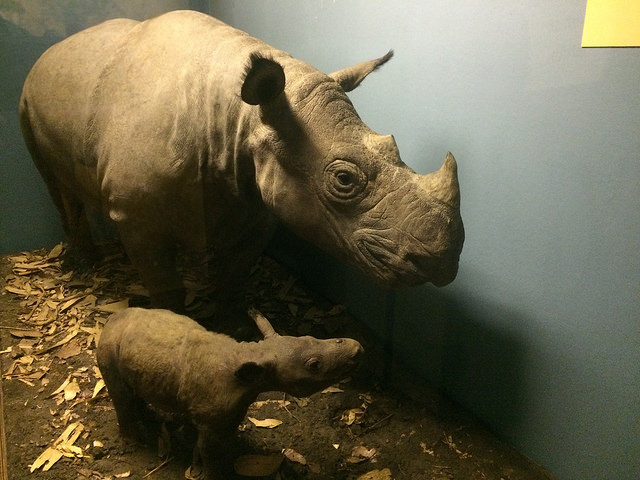
productive old forests are naturally rare in BC. Sites with the potential to grow very large trees cover less than 3% of the province. Old forests on these sites have dwindled considerably due to intense harvest so that only 2.7% of this 3% is currently old. These ecosystems are effectively the white rhino of old growth forests. They are almost extinguished and will not recover from logging.
Way back in in 1992 I wrote an article for FUSE MAGAZINE entitled ‘The State of the Forest: The Canadian Landscape as Propaganda’ where I made case that the ferocious push to eliminate old growth forests, particularly those accessible, lowland forests containing charismatic, cathedral-like groves, was a deliberate strategy to reverse the figure/ground relationship between what is a ‘space of enclosure’ and the a priori ecological commons, i.e what is capitalism and what is not capitalism. I detailed how the language describing forests was being carefully altered by corporations and their client governments in order to strip away any pre-capitalist connotations. In this new corporate forest-speak, primary forests were coined ‘tree farm licenses’ or ‘fiber farms’. The word ‘farming’ serves as stand-in to legitimize the transformation of forests from unenclosed commons, stewarded but not owned in the settler-colonist sense of the word by original inhabitants (either as traditional territory or under some kind of usufruct), to fully enclosed property under what Marx termed ‘primitive accumulation’. There is nothing remotely resembling ‘farming’ about felling primary, old-growth forests, an extractive process more akin to mining or the industrial slaughter the great whales, but the metaphor persists and is actively promoted. Just a few days ago, a logger, Ron Tucker, interviewed during a counter-protest denouncing the Fairy Creek blockade said it yet again:
“We live in the best area in the world for timber and trees and this is what we do. We’re farmers and we farm trees.”
Ron Tucker, logger
Perhaps he even believes this but it is hard to square that notion with the BC government’s own assertion that logging the province’s old growth, forests which no farmer ever planted, remains key to the future of the industry and that 27% of the annual harvest is still dependent on old growth forest.
In my article, I detailed other forest industry neologisms such as clear-cutting with camping allowed afterwards defined as ‘mixed use’, ‘shared use’ or ‘the working forest’, the latter being a particularly galling, faux proletarian obfuscation of corporate extractivism. The forest isn’t exactly working and the jobs created in British Columbia’s industry turn out to be one of the lowest jobsper volume of wood harvested with much of what is felled shipped overseas as raw logs, eliminating opportunities for stable employment in secondary manufacturing and milling. Government subsidies to the industry remain massive even without factoring in the substantial policing costs incurred when an outraged population pushes back and starts putting bodies on the line to defend the last shreds ancient forest as has been happening at Fairy Creek. Police helicopters with specially trained commando units deployed to arrest tree sitters and blockaders along with the round-the-clock heavy presence of ground forces doesn’t come cheap and the costs could in fact far exceed the commercial value of any timber extracted. But this is about more than simple economics.
Charismatic, ancient trees pervade our collective unconscious. Their archetypical images crop up in many religions as ‘world-trees’ or trees of life, connecting heaven and earth. The Norse had their Yggdrasil, the local Kwakwaka’wakw people and other First Nations of the Pacific Northwest coast, worshipped red cedar (Thuja plicata) since time immemorial, carefully prying individual planks from old-growth trees without killing them, leaving them standing to heal. Images of old-growth even pervade such popular genres as video gaming and streaming television. Think of the Weirwood tree in the godswood of Winterfell or pretty much all of James Cameron’s Avatar. Ancient groves symbolize something very deep and meaningful, connecting us to a time before property.
Which is why there is such a push to have ancient trees eliminated except in a few sanctioned parks where they can be commodified as tourist attractions. Instead of being allowed to perform their function as the ecological scaffolding that holds together an interdependent, living landscape, maintaining the stability of the regional hydrology, fish habitat and climate, any old-growth trees allowed to survive get reduced to props in a wilderness theme park. The not-so-subtle message is that all forests are transactional spaces valued only for the readily extractable commodities contained within. Even parks exist primarily to provide marketable experiences to extract dollars from tourists. The battle for Fairy Creek is as much ontological as it is ecological. We are living in a world run by people who hate the symbolism of ancient trees existing just for their own sake. Soon we will even lose the language as to why they should have been left standing in the first place.
‘It exists!’ he cried.
‘No,’ said O’Brien.
He stepped across the room. There was a memory hole in the opposite wall. O’Brien lifted the grating. Unseen, the frail slip of paper was whirling away on the current of warm air; it was vanishing in a flash of flame. O’Brien turned away from the wall.
‘Ashes,’ he said. ‘Not even identifiable ashes. Dust. It does not exist. It never existed.’
‘But it did exist! It does exist! It exists in memory. I remember it. You remember it.’
‘I do not remember it,’ said O’Brien.
George Orwell – 1984.
-
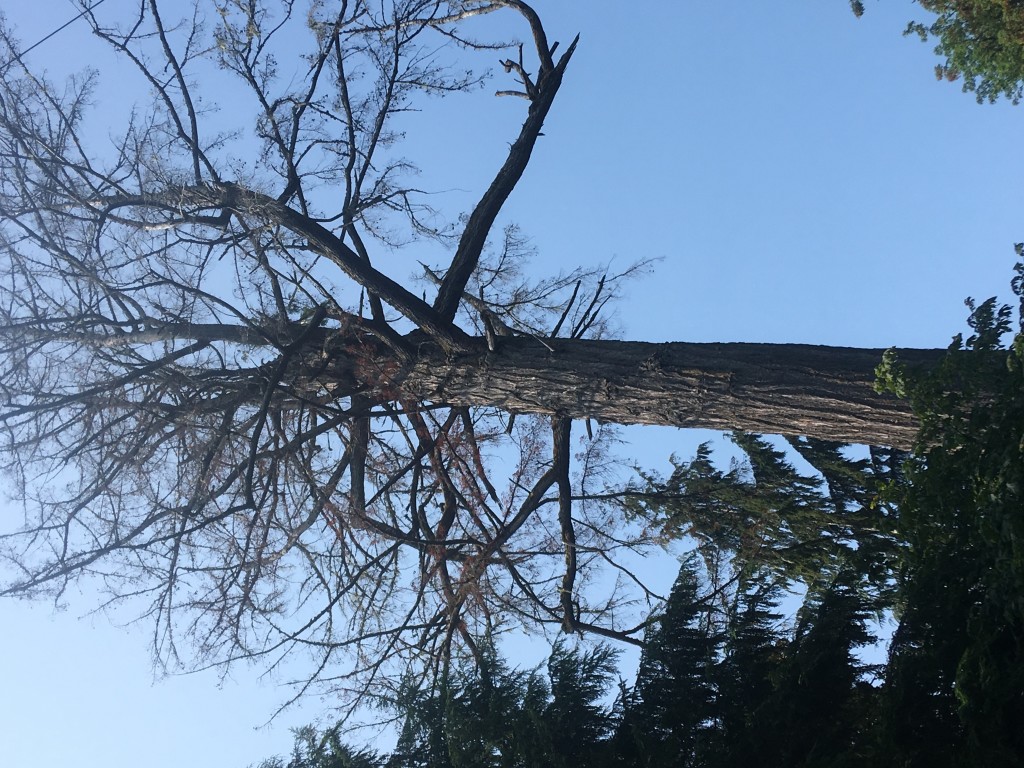 dead after four centuries
I’ve never seen a tree before. It’s pretty!
It’s dead…
Blade Runner 2049
Death is a complicated business and how one might feel about a particular death has a lot to do with how understandable it was, how inevitable. The loss of a loved one, near and dear, opens up a hole and the memories that flood in to fill it, though they might bring comfort, never completely make up for the extinguishment, the permanent elimination of an actual physical being from our lives. It is the finality of death that makes it so daunting. Most of us realize this (of course!) but we wish it weren’t true. We mitigate our grief by imagining our dear departed being ‘in a better place’ or ‘resting in peace’ or otherwise liberated from mortal suffering as if after death some remnant of the self might still remain that is able to experience relief. Who knows? Maybe dead is just dead?
Within the span of a year, I lost both my parents. ‘Lost’ is a strange way to put it – I know where they are – their cremains scattered under some bushes against the red brick wall of an old church beside a highway in suburban Toronto. The ground there shakes every time a big truck rolls by, which is pretty often due to the heavy traffic. Mom and Dad chose this spot many years ago when their deaths still seemed like a far-off possibility. Though they were both in their eighties by the time they passed on, (an average lifespan in Canada which still retains the tattered remnants of a public healthcare system, the way they each died came as a surprise. I don’t know what I was expecting really. Perhaps I had just put the inevitability of them dying out of my mind until the medical emergencies started to pile on, one after the other and their mortality became impossible to ignore. Yet the end of life is an issue we all have to face, sooner or later, ready or not.
As to why my parents wanted to be interred next to that particular church–it was because they’d developed a deep affinity for both the building and the community that congregated in it. That it was a Presbyterian church and they had always identified as German Lutherans didn’t seem to be a problem for them. At the top of a hill overlooking a sweeping river valley, the little church serves as a landmark in the neighbourhood where they had established deep roots. Before his mind started unravelling, Dad spent years as a church elder, overseeing the renovation of the steeple and visiting the sick. The memory garden where I scattered his and Mom’s ashes was installed by my brother, his first major commission after landscaping school. Our family home was just down the road in an old red brick house of similar vintage to the church, since we moved there in 1969. My parents lived there until it seemed prudent for them to downsize to a nearby apartment when Dad started his long decline.
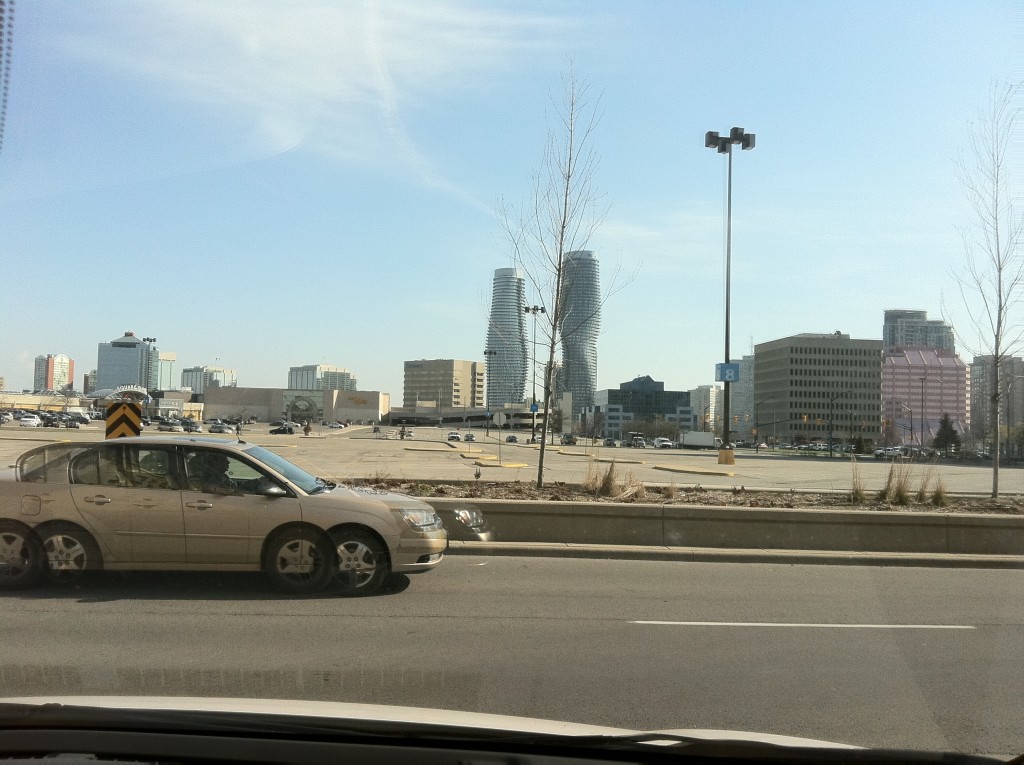 not cornfields anymore! Mom and Dad arrived in Canada in the late 1950s as impecunious immigrants from a war-ravaged Germany and I was born shortly thereafter. At that time, Dad did night shifts in a styrene factory as well as serving as the superintendent for the walkup apartment building where we lived. Mom toile away as a supermarket cashier. With the hard work and determination of the immigrant working class, Mom and Dad eventually rode the surging tide of Canada’s postwar economy from their blue-collar beginnings into the ranks of the lower middle class. The high point was when Dad got promoted from the factory floor to salesman, a job that came with a company car. When that happened, Mom celebratoriously ditched her unionized cashier job for a less remunerative one as a bank teller which she thought conveyed a higher social status because she could ‘wear nice clothes’ and not be spending her days stuffing bleeding chickens into paper bags at the cash register. Mom and Dad weren’t the bourgeoisie exactly but they genuinely felt they had made it in this new land of opportunity. We children came along in tidy five-year intervals, first me, just squeezing into the tail of the 1950s, my sister following in 1964, and my brother in ’69. Dutiful and committed, my parents continued to build their immigrant dream, rarely complaining through life’s many trials and reminding us children on regular occasions life was ‘so much better now than it was during the war,’ which of course it must have been – not that we were in any position to judge. They maintained decades-long friendships, mostly within the German diaspora and gave their time generously to various community causes. After all those years of living, loving and helping others, their lives simply ran out, one after the other, within the span of just over a year. We who were bereaved are left with our memories of course, but in the end, all that was left of Mom and Dad was sticky grey ash, not even enough to fill the small wooden box which I carried out to the churchyard to sprinkle onto the shrubs.
So how did it all go down, their deaths? And did they make any sense?
On the face of it, the way each of my parents’ lives ended did make some basic sense though it would be nice if they had been able to live a bit longer. Their lives each spooled out as all of ours will–my mother’s abruptly, and my father’s more slowly. The details will vary of course, but the end is assured. The luckiest of us might get to die peacefully in our beds deep in old age but for the rest, our demise might just as easily be precipitous. Life expectancy in OECD countries like Canada is currently averaging at 80.3 years. In the US, where I now live, the expected life span is actually dropping but still averages out at 78.7. Mom and Dad both made it past the eighty-year mark and thus died within an unremarkable window of longevity.
Before his Alzheimer’s, Dad had struggled with two major bouts of cancer, a legacy of his time working with toxic chemicals – first in a styrene plant, around the time that I was born, then subsequently in a factory producing Fiberglass fronted concrete blocks, conceived to speed up the construction of fast-food restaurants that were popping up like mushrooms all over Toronto’s rapidly-developing bedroom communities like the one in which we lived. My earliest memories of Dad are his smell. I remember the odour of burnt styrofoam emanating from the pores of his skin when he brought his face close to mine after returning home from the plant. The car upholstery smelled the same way, having absorbed his plastic-scented perspiration. It was just the way Dad smelled and the presence of his personal polystyrene cloud served to comfort me and made me feel safe.
Mercifully his cancer didn’t kick until he was nearing retirement, albeit a retirement that was involuntary, due to a corporate merger that subsumed the company he had given so much of his life to, from his years in the plant to his ascendance to the sales force. Neoliberalism had hit its stride after NAFTA was signed and the good jobs in Southern Ontario’s manufacturing heartland began predictably evaporating as companies took advantage of the opportunities to shift production to countries where labour was cheap. All over the region, legions of loyal workers were cut adrift. For many like my father, the immigrant dream was beginning to unravel.
I can’t help thinking that the psychological stresses of this precarious time strained his health, but at least Dad saw see his children grow up before getting hit by the big ‘C’. When cancer came, he took it surprisingly in stride. The first round was a near-fatal non-Hodgkin’s lymphoma, cancer that typically affects workers exposed to the type of chemicals that are used in plastic manufacturing. Intense chemotherapy was needed to bring it under control and even then, it was a long time before his remission could be assured. The irony that it took exposure to toxic chemicals to cause cancer and more toxic chemicals to take it away was not lost on Dad. By the time he was in remission, Dad was wrung out and never again regained his once-prodigious vitality. His personality changed too and he became much more reflective and less prone to the piques of anger he had been predisposed to. To those who loved him, it was a change for the better and I was moved to hear him talk about the long hours he spent volunteering at the cancer ward where he himself had been treated, reassuring anxious new patients splayed out on the leatherette recliners with chemo transfusions coursing through their blood vessels. I have no doubt his quirky humor and general bonhomie kept more than a few cancer patients from sinking deeper into their despair and I got the sense he was suddenly determined to give something back to the world after himself being granted a new chance at life.
But it wasn’t long before another cancer swooped down on him like a malevolent front – bowel cancer this time. The good news was it had been detected early and his doctors were guardedly optimistic he might recover. The surgery went without complications but disaster struck during what was supposed to be the postop. Dad was nearly killed when the hospital staff ill-advisedly rushed him into eating solid food. Not wanting to disappoint but nauseous and still in pain, Dad choked and inhaled his own vomit, the violent coughing that ensued bursting the sutures in his intestines. Emergency surgery followed but he was now also struck with aspiration pneumonia triggered by the food sucked into his lungs. He went from a cheerful convalescence to death’s door in the matter of a day and was unconscious in the ER amid beeping machines. Called to his bedside, I expected the worst. Flying in from British Columbia, I made sure to pack a dark suit to wear at his funeral, which everyone agreed was imminent. Amazingly, by the time I had arrived, the tide had turned and his doctors were allowing he might make a slow and somewhat complicated recovery. Mom, ever the tireless caregiver, nursed him through the multi-month convalescence that followed
Dad slowly recovered but his weakness was intractable and he seemed mentally dissociated. Though things at first seemed hopeful, in a cruel twist of fate, his cognitive state started showing signs of worrying impairment. At first, it seemed like post-surgery depression but then it became clear something more serious was wrong. The initial bouts of confusion he suffered after moving into the new apartment progressed into bouts of catatonia and continued exhaustion that worsened by the month. Dad lost his ability to speak, outside of a few unintelligible mutterings and refused to be roused from his bed. Mom was angry at him, accusing him of ‘just not making an effort’ but he continued to stare blankly into space. Alzheimer’s was confirmed and Mom’s toil now became never-ending. She had to cajole him into eating, and if he did put food into his mouth, make sure he remembered to chew. A cautious driver, she ferried him to countless medical appointments throughout the vast suburbs and as he was now incontinent, launder endless loads of his soiled undergarments and bedding. It wasn’t long before Mom slipped into a serious depression and she confided in me during her telephone calls to me in New York, where I was now living, that she was losing hope. Mom’s Sisyphean labours ended only when Dad happened to fall out of his bed one day, breaking his hip. As he recovered in hospital, the medical team finally realized the severity of his mental impairment and fast-tracked him into a dementia care facility. It had been obvious to all of us that my increasingly frail mother could no longer cope, and sad but relieved, she began to realize that with Dad taken care of, she could begin to focus on her own health issues.
Yet paradoxically Mom died before Dad did. It was sepsis that killed her after routine hip surgery; surgery I’d been hectoring her to have now that she had the time to begin looking after herself. Mom had been suffering from hip pain for years, affecting her sleep and forcing her to rely on a cane, which she hated. Her GP told her she was an ideal candidate as she was relatively fit for her age.
‘Go get your hip fixed..’ I implored her. ‘It’ll improve your life and you can ditch that cane.’
I soon came to regret those words and my naive faith in the infallibility of modern medicine.
Mom’s was a painful passing. She’d been recovering well after surgery and my brother had prudently booked her in for a temporary stay at a care home so she could recuperate with regular meals and monitoring. After Dad had been institutionalized, Mom was increasingly forgetful when it came to taking care of herself. When the time came for her my brother to take her home, she seemed lethargic yet still eager to leave. She was having trouble dressing and on the way down to the car, she collapsed in the elevator. By the time she was in the hospital emergency room, it seemed at first as if it was nothing more than a touch of the flu but soon her condition became much more serious. Mom’s vital signs were in freefall and the doctors scrambled to identify a virulent infection raging through her body. Her tissues started to swell and she became wracked in unimaginable pain. Mom soon lost consciousness and was dead within a couple of days. I sat vigil by her bedside as the voracious bacillus ate its way through her organs, while outside the window of the newly-built suburban hospital, sprawling over the featureless vastness of what used to be farmers’ fields, the gold and vermilion foliage of an Ontario autumn scintillated under the gas flame blue sky. Mom drew her last breath and I flew back to NYC to return to my work and await her upcoming funeral. A couple of weeks later I was back, standing in the churchyard, clutching a small wooden box that contained all that was left of her –a pile of grey ashes and some flecks of white bone.
As the first-born, the pastor instructed me I was to be the first to scatter her ashes. It was, to be honest, a little awkward, as there was a stiff breeze blowing in from the highway that caught them up, swirling them around me as I struggled to dispense the box with at least a modicum of dignity. My jacket sleeve, wrist and hand were soon covered in a clingy grey film of Mom’s mortal remains as the line of mourners formed to shake my hand. My melancholy flipped quickly into anxiety as it seemed crass to concern myself with tidiness at such a solemn time, to be wiping Mom off –the last vestiges of my mother’s corporeal existence– onto a scrunched up wad of toilet paper I had been kneading in the pocket of my jacket, while everyone else was watching, scrutinizing even, my performance with such focussed kindness and compassion. There was really no recourse, so for the sake of decorum, I turned away for a second and wiped my hand, just my sister was taking her turn doling out the cremains, my brother standing by her with the tears welling up in his eyes. It was all over in a few minutes, the last traces of Mom melding in with the topsoil and mulch (well more or less anyway–there were a few alarmingly un-melded spots I was hoping the groundskeeper would see to– the highway traffic unabated in its thrumming and the assembled party filing into an adjacent reception room for a buffet of coffee and sandwiches and a spread of homemade baked goods that would have truly lifted Mom’s carbohydrate-admiring heart, had she been present on this earthly plane to partake of it. Dad, mute in his dementia, sat transfixed in his wheelchair. He hadn’t uttered a word for the past several months and Mom had been taking it quite personally, despite the unambiguousness of his diagnosis, still stuck on the idea that somehow he was shutting her out when she made such an effort to visit him on his ward. During the service, Dad seemed to show some slight flicker of recognition when confronted with familiar faces from his congregation and he gazed searchingly into the eyes of those greeting him, though there was no indication he comprehended the tragic reason for this occasion. Perhaps it was better that way. Dad had been a mercurially emotional man. Though his relationship with Mom had been complicated in terms of its power dynamic, losing her after over 65 years of marriage might well have unmoored him beyond recovery had he still been in his right mind. But he wasn’t in his right mind, and that was that, and though my siblings and I hoped he might still have some sense of how much we all loved him, what remained of his subjectivity was now completely opaque, stuck in a labyrinth of blind neurological channels, mired in amyloid plaque.
The death of someone we love is so emotionally overwhelming, one is bound to perceive the moments around its occurrence differently from more quotidian happenings. It is the details that stand out, the small things, and the sensation of Mom’s ashes coating my sleeve, wrist and hand will always be with me. Life, as we know it at any given time, exists in a swarm of such moments, a cloud perhaps, and yet some of these fleeting perceptions manage to lose their ephemerality and become fixed in our memories, a permanent reminder of who we are, who we have been, the transitions through which we have passed, though they might only have lasted an instant, like the dust of Mom’s ashes swirling around me in the stiff breeze beside the highway, the way it felt in my hand, the sound of traffic humming as it passed.
The following spring, in a nondescript care home unobtrusively situated in the vast planar landscape of strip malls and low rise office buildings that characterizes Toronto’s amorphous edge, Dad’s decline suddenly accelerated. In keeping with the advance directives he had long ago prepared while still of sound mind, there was to be no medical intervention once he started refusing food and could no longer be roused from bed. He had, as I was told, spent previous weeks withdrawing even further from interactions with his caregivers, though he seemed beguiled occasionally by some atmospheric thing like the flash of windshields from the traffic outside his window bouncing off the ceiling of his room. He showed no signs of unhappiness or agitation, but rather what had remained of his neural functions were now simply shutting down, which to his nurses signalled his life was drawing to a close. We gathered by his bedside to wait for the inevitable; me, my brother and sister and their spouses, while various friends and former neighbours came and went, paying their respects, sharing memories, making small talk with us and drinking coffee. Dad had been a gregarious man and though now unconscious, we all shared the thought he might have been comforted by all of us being there. He wouldn’t have wanted to die alone. The weather outside was pleasant and we had just returned from stretching our legs in the sun-bathed parking lot behind at the back of the building, clutching takeout coffee cups, chatting as we had been to pass the time, and as we reentered Dad’s room, we noticed his forehead strangely twitching and a sudden shift in the tone of his skin. Failing circulation had swollen his fingers into tumescent sausages and a grey shadow began to adumbrate his face. A purple stain that had earlier appeared at the top edge of his ear had spread ominously and from that moment his life leaked out of him apace. Outside it was a warm May afternoon with the long-dormant soil beginning to smell again of life and fecundity. The vernal light streamed in through the blinds in golden shafts, illuminating the antiseptic surfaces of linoleum and chrome. When Dad stopped breathing, my brother-in-law began to sob. The Tim Horton’s coffee cups still absurdly clutched in our hands, we stood there together wordlessly, my sister sobbing softly before we felt it was time to call in the duty nurse. It wasn’t long before Dad’s ashes too were trickling through my fingers onto the boxwoods and rose bushes of that little churchyard beside the highway, the trucks rumbling by and the sandwiches waiting in the reception room. The old Latin adage, Nos habebit humus– the earth shall have us–never seemed truer.
With the loss of my parents, a part of my world disappeared. I have myriad memories, of course, some good, some not so good, but the living, breathing individuals who conceived me are now irrevocably subsumed into the topsoil beneath a row of ornamental shrubs. Random, disjointed images keep flooding in from my preconscious childhood. I am playing with building blocks on a parquet floor. The sun streams in from between the curtains. My mother is reading in an armchair holding a cigarette. In the blue curls of her smoke, I notice for the first time teeming motes of dust – each in its own inscrutable trajectory yet somehow keeping its distance from its neighbour, each illuminated in golden light, a specific quality of light that continues to enchant me, the light of life, the light my father still marvelled at with his addled brain as it reflected off passing windshields onto the ceiling of the room in which he died, the warm glow of the sun returning to a northern spring after an intractable winter. I must have been gesturing somehow, open-mouthed and inchoate at the dust dancing in the shafts of sun, golden motes suspended in the peacock blue smoke of my mother’s exhalations, and she must have been watching me when she whispered conspiratorially –‘Die Piraten kommen!’– ‘the pirates are coming!’ I believe I burst into tears. Perhaps it was some magic that floated in the air that day. Perhaps it was an early warning. I didn’t know exactly what ‘Piraten’ meant but I suspected it might not be good. It was perhaps the first time I was made aware that in the present there could be some portent of the future.
When I think back on it, my parents at that time were probably quite sensitized to the notion of omens – the idea that there might be small signals in any given moment that presage cataclysm. They did, after all, as children survive the firebombings of Stuttgart and regaled me from an early age with horrific stories of charred corpses laid out on the cobblestones after the air raids, bodies incinerated to the size of bread loaves, and how all this ensued after a charismatic man by the name of Adolf Hitler somehow got into power and how things seemed so great at first with all the newfound pomp and ceremony, the trains running on time and those proud swastika flags flying everywhere before it all fell apart and the true nature of the evil that had been unleashed became increasingly apparent. If there is any truth in current theories about inherited trauma, epigenetically transferred, it might explain my own lifelong twitchiness despite a childhood in the safe, stuffy suburbs of Toronto. Perhaps this constitutes some as yet undescribed biological early warning system which sees the children of trauma survivors serve as societal antenna, predisposed toward vigilance for signs of emerging disaster. It’s all in the details really, the perceptions we experience from moment to moment, the flux of sensations we aggregate into worlds in which we find meaning. The thought we might inherit the trauma of our ancestors, despite not having experienced it directly, is unsettling. Do these shadows of the past predispose some of us to be canaries in the coal mine? The rustle of leaves might presage a storm, a mean-spirited remark–nascent fascism.
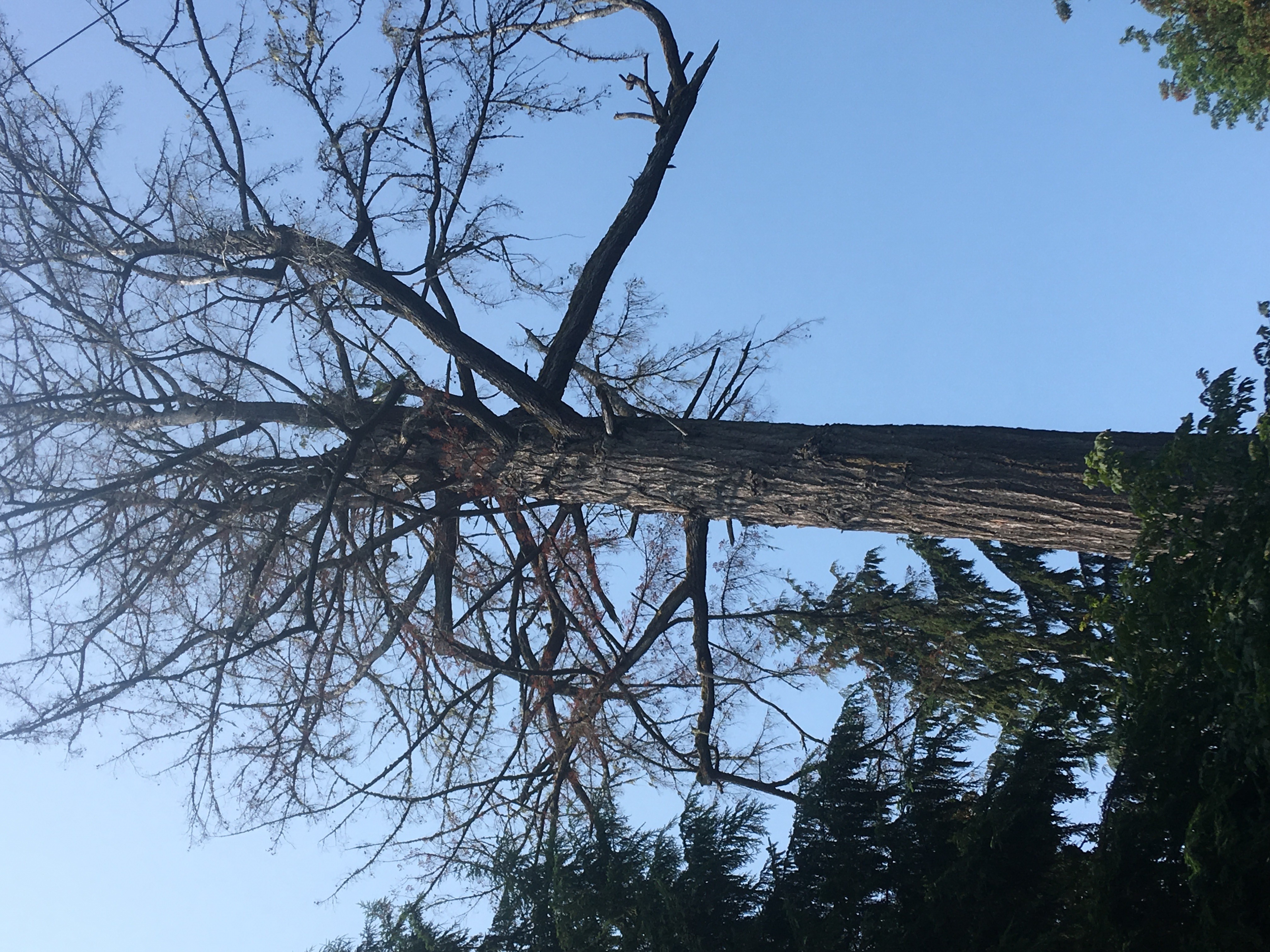
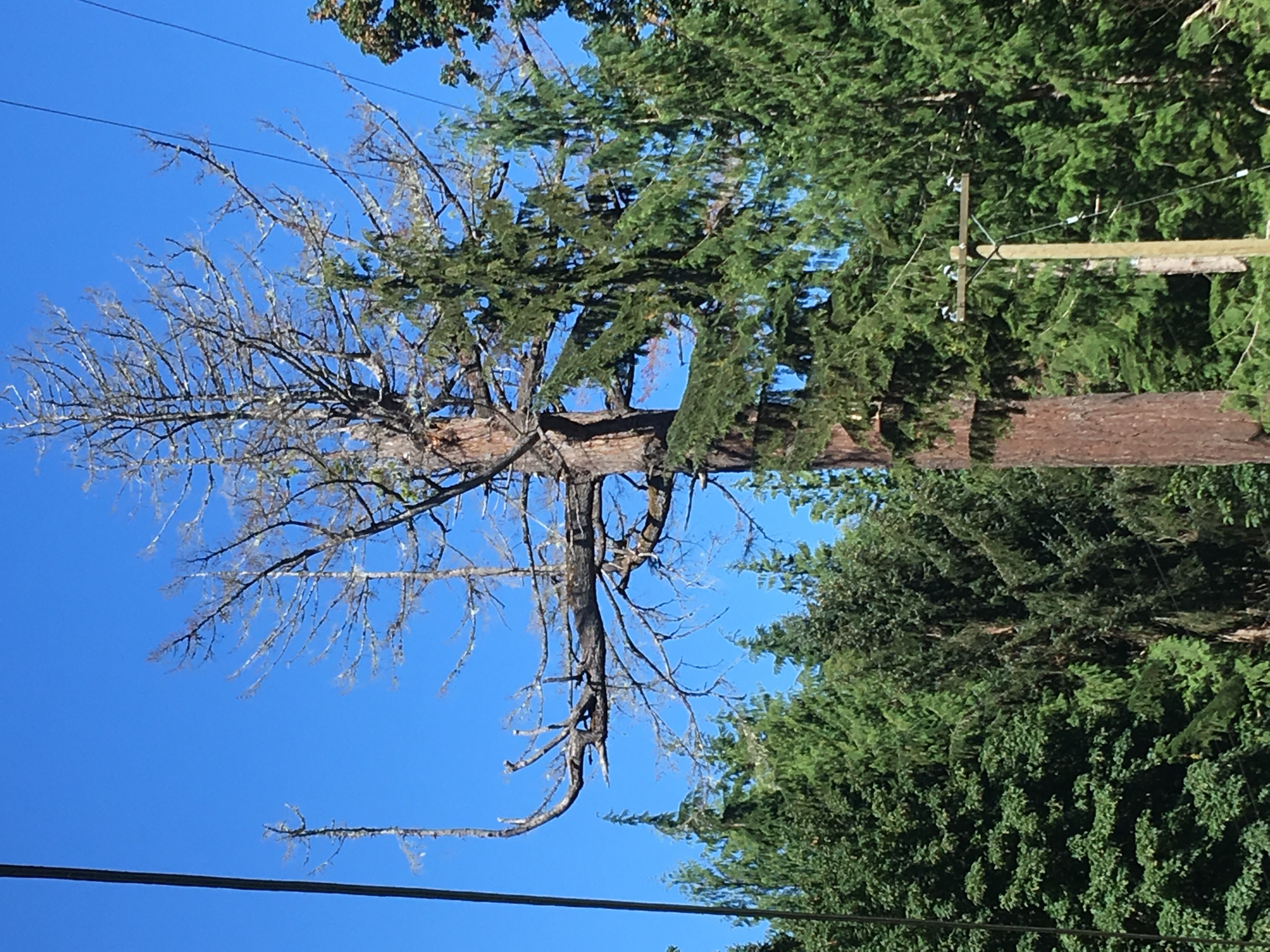
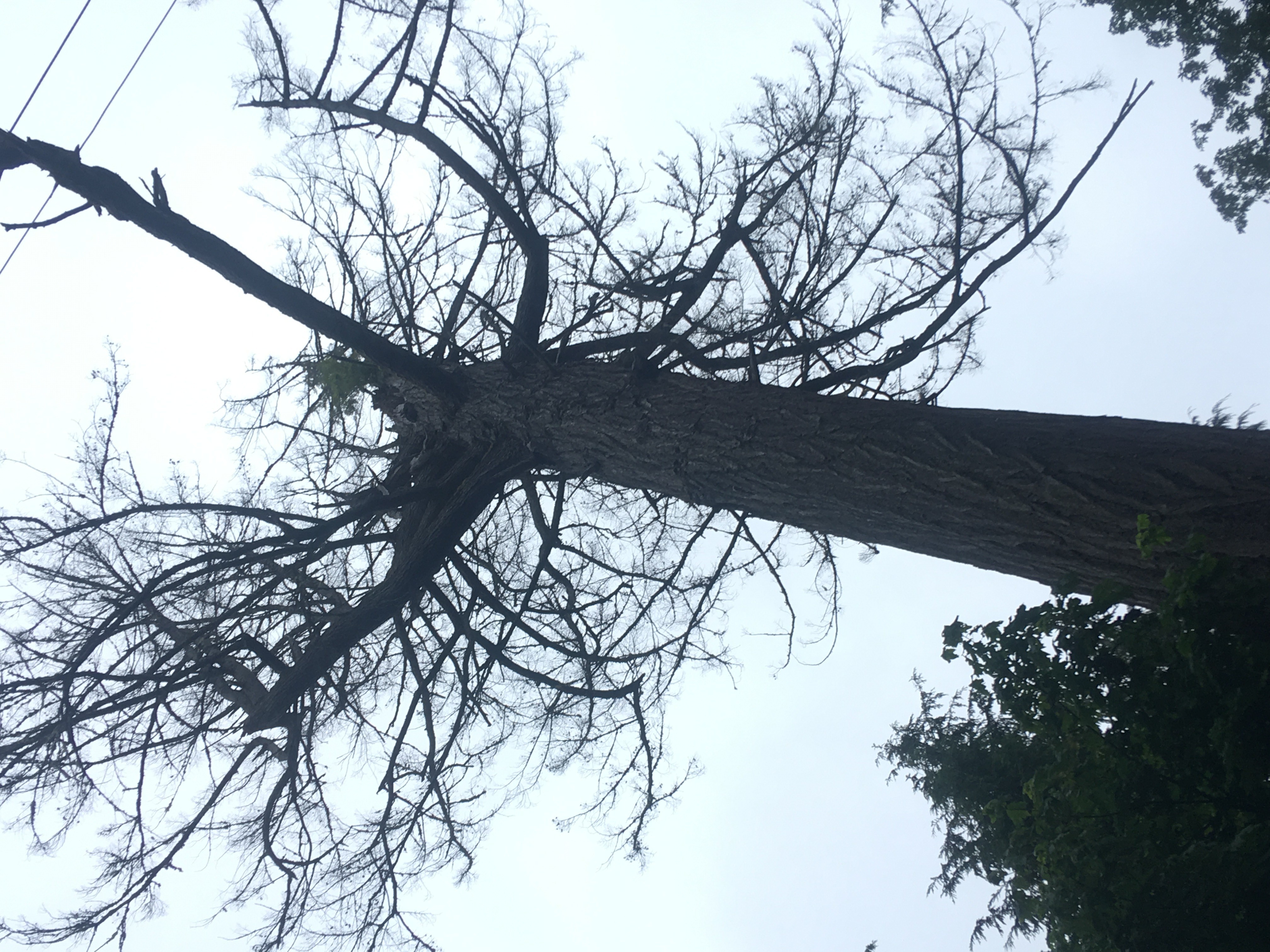
Which brings me to a tree, an ancient and immense Douglas fir, whose death I observed over the past few years down the road from where I lived for a time on a rather remote island in the twinkling Salish Sea. It is, or rather, was, an old-growth tree, a so-called veteran tree that somehow survived when the primeval forest all around it was felled and boomed off to distant sawmills by two or three generations of settler-colonists. Judging by its height and girth, this fir had been growing for well over four centuries and it was alive and well when I first encountered it in the early 1990s. Knowing it was there, even when I was far away, calmed me. I thought about it often in my East Village apartment, the din of sirens and the drunken arguments erupting outside my window. I imagined it slowly accreting its growth rings as it always had, the only sound the soughing of needles high in the crown, the branches there festooned with tufts of greenish-white lichen that quivered in the slightest breeze, the monumental, corrugated column of its trunk rising vertiginously into the winter mist, the fire-blackened bark of the enormous base upholstered here and there with cushions of viridian moss. In a tumultuous world, there was at least this: an ancient being somehow outlasting the depredations of capitalism – a vestige of a lost arboreal sublime, a nonhuman subject so incongruous with modernity, I could only gasp at its presence. It stood as a defiant exception, a marooned titan whose colossal kin had long ago disappeared into the horizon – a reminder of what there once was, of what once was possible before capitalism subsumed everything into board feet and dollar figures to be scribbled into ledgers.
But the old fir died and it did so rapidly. Unlike my parents, it wasn’t necessarily nearing the end of its natural life. For Douglas fir, a lifespan of 600 -800 years is not uncommon and there are records of up to 1400-year-old trees elsewhere on the coast. The signs of its demise were subtle at first –a slight browning of the needle tips after an uncharacteristically hot and witheringly dry summer. Though somewhat in the rain shadow of Vancouver Island, the island’s climate was considered maritime, generally characterized by a couple of fairly dry months in summer followed by 10 months of bucketing rain. The vegetation was classed as a temperate rainforest with all of the verdant mosses, glistening ferns and outsized fungi one might expect in such fecund conditions. Coastal Douglas fir is exquisitely adapted to this habitat and some of them number among the tallest and oldest trees in the world, comparable in size to the storied redwoods of California. Though the more accessible trees had long ago been plundered from the island, (which incidentally is named Cortes Island after one of the worst colonial plunderers of all time), there still remains a relic population of massive specimens that protrude here and there from the scraggly second-growth, looking like lignified watchtowers, the storm-wracked crowns often splintered and bent into expressionistic candelabras that are the favoured perches for bald eagles surveying the vastness of their airy domains.
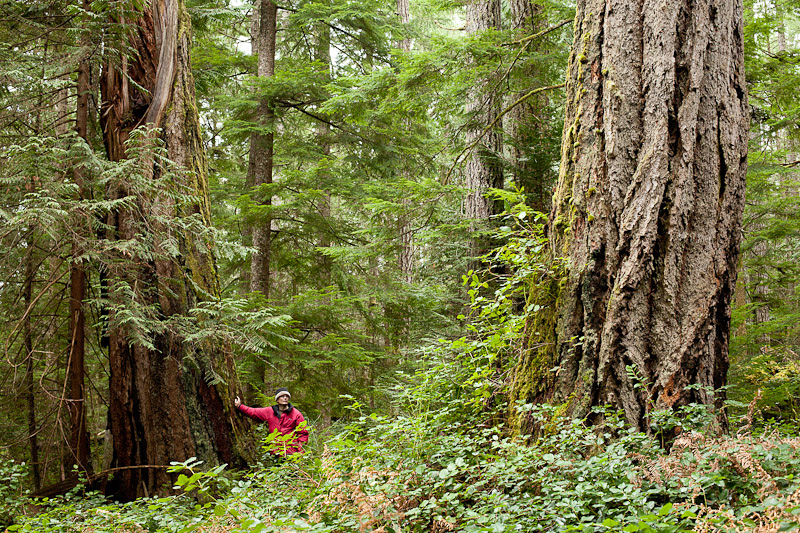 Old-growth Douglas fir on Cortes Island
The fir down the road was a particularly magnificent example. A strange lumpy growth, Agarikon fungus, hung like a Venus of Willendorf under a massive transverse limb. Agarikon is regarded as ‘shaman’s bread’ by some First Nations. It often is curiously anthropomorphic and was esteemed for its ability to cure a range of diseases. The fungus had become an object of attention recently, when the celebrity mycologist, Paul Stamets sent a climber up the old tree to retrieve a sample. In his lab, Stamets extracted novel compounds potentially effective against such deadly human pathogens as anthrax and tuberculosis. Agarikon is symbiotic with old-growth Douglas fir and thus its survival is threatened as the ancient trees are exterminated. Less than 1% of the original old-growth fir forest remains along the eastern side of Vancouver Island, where it once dominated the landscape. The scant few veteran trees that survive are thus incredibly precious, not only as living reminders of a prelapsarian past but as an indispensable habitat for organisms such as Agarikon and many more yet to be catalogued. The very biggest trees support a rare arboreal soil constituting a unique ecosystem, a kind of microcosm populated by microorganisms and invertebrates unknown on the ground. We may be running out of time to find out whether one of these might contain, for example, some novel antibiotic or a cancer remedy. The last old firs are disappearing too fast.
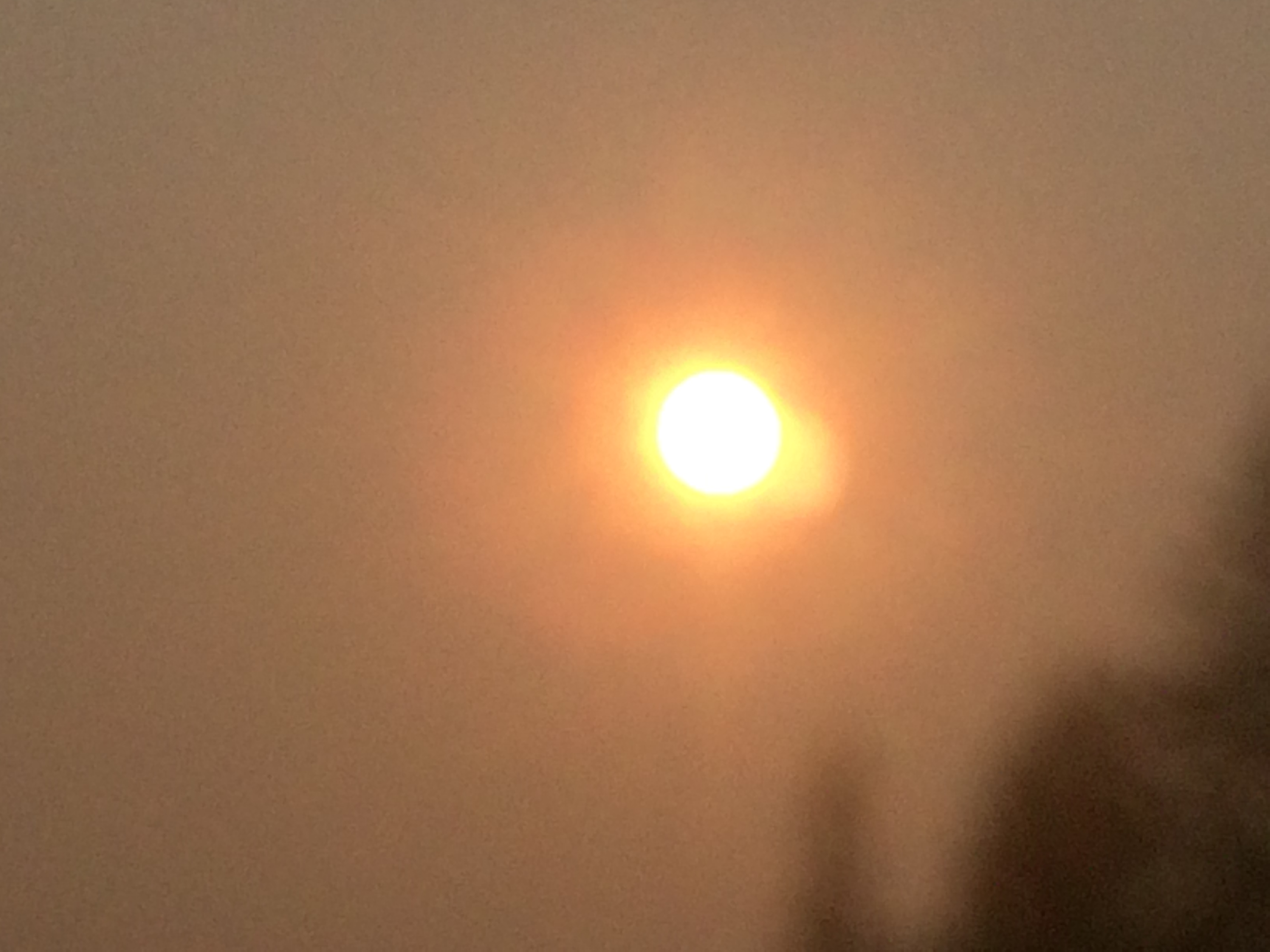
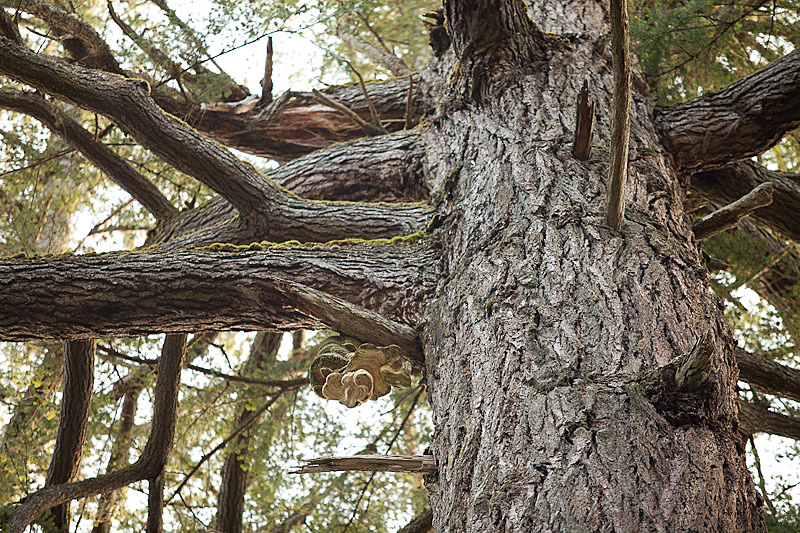 Agarikon on fir some years before the decline The following summer was again unprecedentedly hot with temperatures almost daily breaking long-standing records and accompanied by a pitiless drought. The halcyon days of July and August I had been so used to, the cerulean dome of the sky, the gentle ocean breezes, were now occluded in apocalyptic orange with the noonday sun brooding over the silhouetted evergreens like a bloody eye or some celestial stoplight the planet had switched on to tell us all it had finally had enough. My throat rasped and my eyes seeped as I walked past the local campground listening to the muffled coughing of holidaymakers cowering in their zipped-up tents. The interior of the province was on fire and plumes of Stygian smoke billowed out from the mainland inlets and across the Desolation Sound, yes it’s actually called that, its waters now warm as urine, enshrouding the little island in eerie twilight, with skeins of acrid vapour clinging to any irregular surface for days then weeks.
As for the fir down the road, the dead needles that had only begun to be apparent the previous summer had now spread throughout the crown as if scorched by the poisoned breath of a basilisk. The Agarikon I had always admired as I passed beneath it had somehow just disappeared and I imagined its lumpy form shinnying down some moonless night to rejoin its long-lost colleagues in the mycelial underworld to maybe just wait this one out, to return, perhaps, once we’d made ourselves extinct to feast on our littered corpses.
Before these summers of smoke, Cortes had seemed a blissed-out sort of a place, at times annoyingly so when it bordered on the smug and self-congratulatory, a kind of loose compendium of anti-vaxxers, cagey-eyed preppers and Subaru seniors of the bird-watching sort in pastel Patagonia and sensible hiking boots, with a sprinkling of New Age utopianists, invariably Caucasian but with exuberantly died ethnic clothing. The demographic skews heavily toward flowing grey hair and old although there are always a few young, mostly itinerant, earth muffins, trying to make a go of it stocking shelves at the Food Co-op or doing laundry at the New Age retreat center. I garnered some incredulous looks when I let it be known I now needed two puffs from my asthma inhaler and a face mask just to make it through my daily run. Ruth, my normally robust wife, came down with chemical pneumonia from the incessant and unavoidable smoke that curled around our eaves and seeped into every cranny. She spent 3 weeks bed-ridden wheezing and coughing and heavily medicated during what should have been a restorative interlude in our hectic yearly schedule. But this is paradise! This will all pass! And indeed it was once a paradise, at least for those with the means to enjoy hand-crafted cedar houses nestled among whispering conifers with views of snow-capped mountains and azure expanses of the warmest tidewaters north of California. Humpback whales still cavort charismatically among the bellied sails of recreational yachters, living out their baby boomer dreams, we made it man! the more fitness-minded among them earnestly shovelling at the limpid waves as they recede into the horizon of their next carefully-curated kayak adventure. Yes there are stubborn pockets of rural poverty and the infrastructure is in serious decline, but nobody likes to talk about that for fear of a bummer vibe.
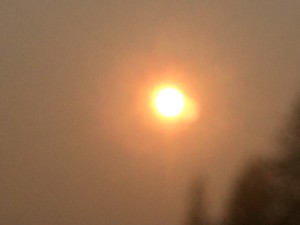 summer of smoke By the third summer, the old fir I had loved so dearly was really and truly dead. The branches once redolent with fragrant fans of blue-green needles now rattled like dry bones in the too-warm air with the lacework of their desiccated twigs tinged in an insalubrious orange from which a few dead cones still hung. Though I was heartbroken, the great tree’s demise seemed to pass mostly unnoticed. The ‘don’t worry be happy/the universe will provide’ cult of magical thinking is strongly enforced on Cortes Island, a kind of unquestioning loyalty to a failed utopia I have come across throughout the Pacific Northwest, despite the mental health emergencies, suicides by overdose and domestic abuse situations that plague the place. A brutal murder some years ago was met by a wall of silence from islanders, who seemed unable to accommodate this grim event into their idealized conceptions of the place, which I imagine resembles something off of a Celestial Seasonings tea label, populated by Smurfs, polka-dotted mushrooms and flaxen-haired children feeding absurdly tame wildlife.
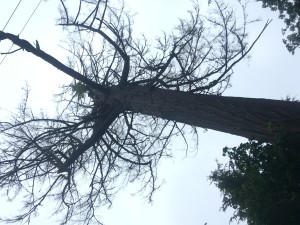
For now, the imposing column of the fir’s great trunk still towers over the T-junction near my former home, but beneath its thick bark, the sap vessels no longer defy gravity to convey their nourishment to the needles high up in the crown, where the buzzing chloroplasts magically plucked photons from the sunbeams and enchanted the monumental scaffold of wood and bark that supported them into a living, breathing colossus. For hundreds of years, the fir endured, wracked by howling southeasters, wrenched by sodden oceanic snows, baked under the hyper-illuminating sunshine of dog day summers when the ground fires tore around its feet, each new generation of woodpeckers incessantly chiselling, the gnashing mandibles of numberless wood-boring insects, persistent and unforgiving, the endless fallout of microbes each seeking purchase to infest and spread rot – it endured all of this until a new variable was added into its equation for survival. This variable was borne a world away in Great Britain where the economic innovation of capitalism married the brand new idea of fossil-fuel-powered machinery, a union that was to unleash long-sequestered gases that began to heat up the atmosphere, a process that progressively accelerated and is now raging uncontrollably. I won’t bore anyone with the details –the record temperatures, the extremes of all kinds of weather–we are all aware of the grim and continuously unfolding litany of climate change, but at some moment, just a few years ago, that very old Douglas fir beside the country road on a little green island far out in the Salish Sea just couldn’t take it anymore and began to die. Others like it are dying too, all over the island and up and down the Pacific Coast, as are the giants in other parts of the world, the baobabs, the sequoias, even in hard-fought-for protected areas that assuaged us into thinking that at least these would somehow be safe. But they’re not safe, with the biggest and most venerable trees succumbing increasingly to a kind of aneurism elicited by the stress from the unprecedented extremes they (and we) are now experiencing, conditions that go far beyond what their genetically determined strategies for survival have equipped them to endure.
Perhaps someday no one will miss these old-growth Douglas firs that for so long made the coast of the Salish Sea a place unique to the world. In a generation or two, the big trees will likely all be gone as global heating continues apace, vanished into oblivion like the passenger pigeon, the Steller’s sea cow and the California grizzly bear before them. Though future generations might marvel at their images on the page or on the screen, or count the rings of a salvaged cross-section hanging in some museum, we will have lost the opportunity to experience the grandeur of these living, breathing beings whose lifespans once far exceeded our own, whose survival into the deep horizons of time once gave us the opportunity to contemplate the ephemerality of our existence. But I have stood beneath them, some of the last of them, when they were still lush and green, traced my eyes up along their towering trunks, and listened to the poetry of their whispering boughs. And for as long as I might continue to live, I will cherish their memory.
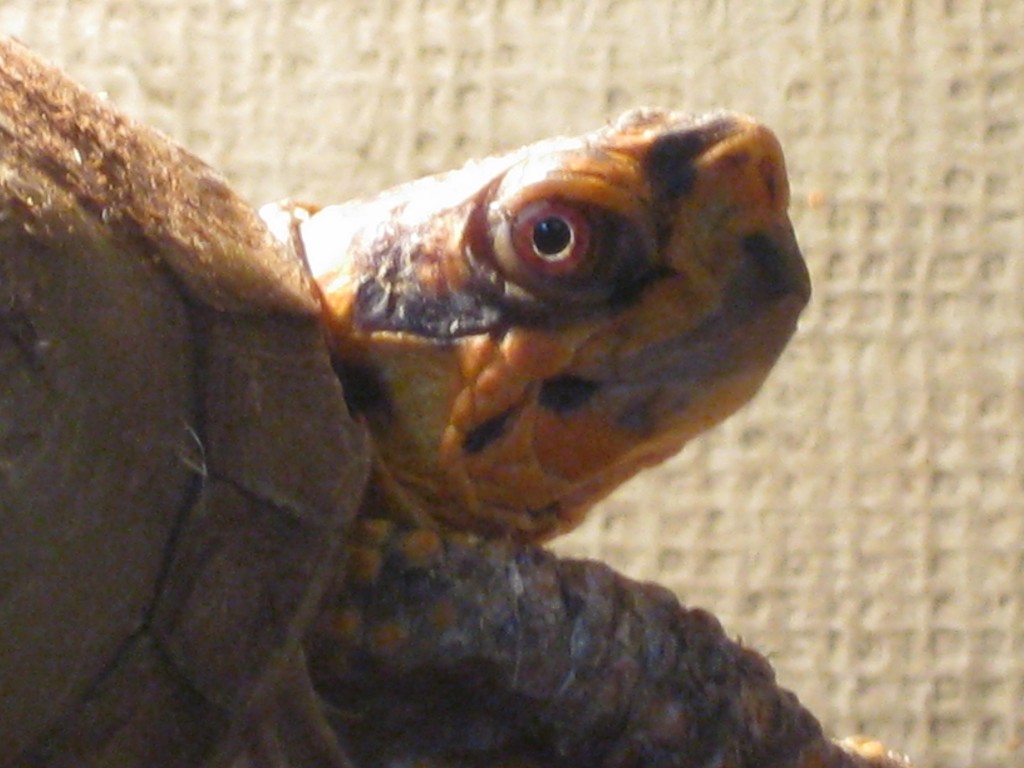 a life companion To be, just for a moment, in the mind of another is a worthy ambition – all the more so if the being whose head you want to get inside is a non-human being.
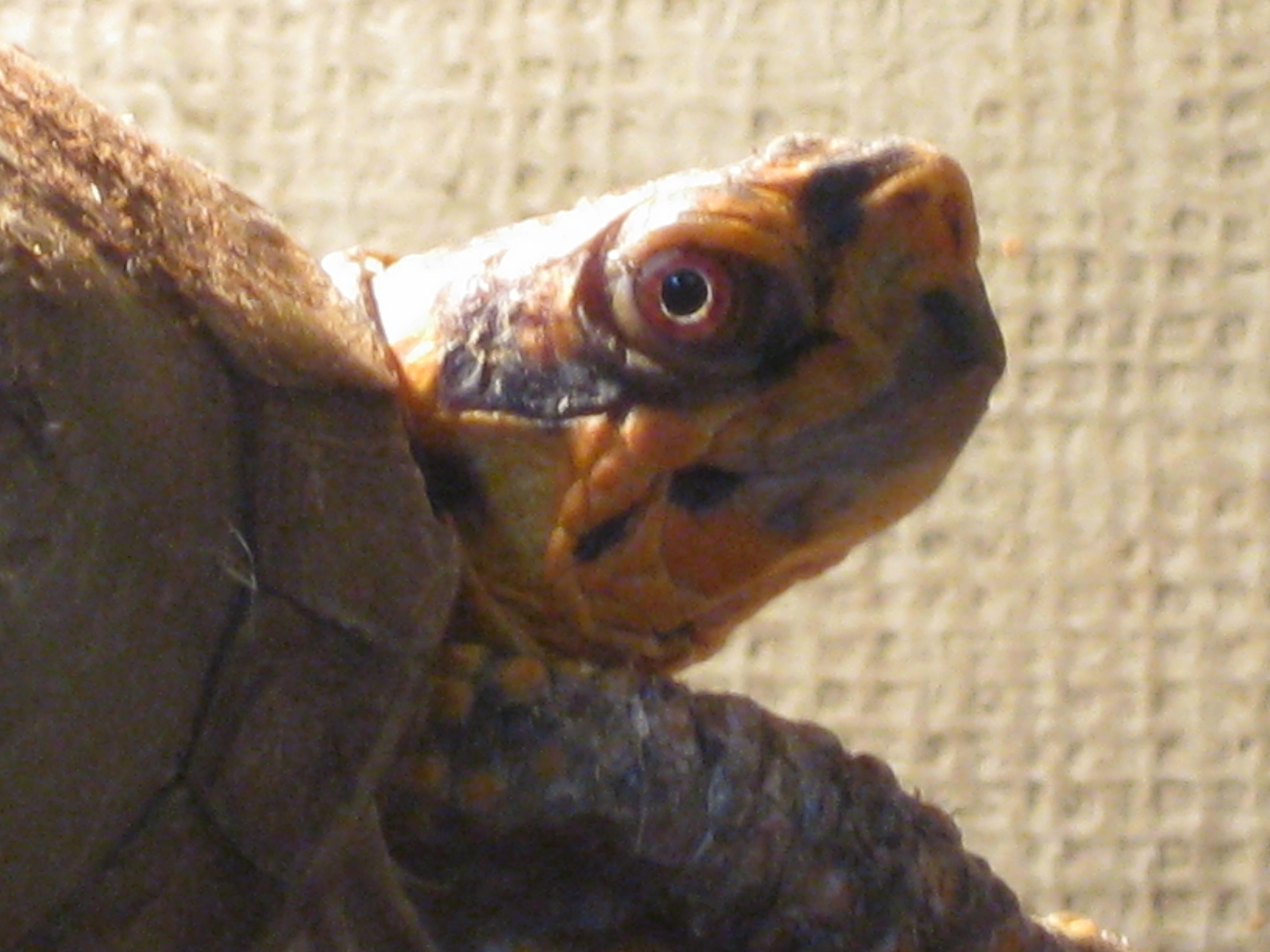
As I type these words, my box turtle Marmaduke is staring up at me from the floor beneath my desk. Having lived with him for than 48 years, I know this particular expression means something: very likely that he has noticed his dinner bowl is empty or that the leftover food therein has dried out. In his own reptilian way, he is telling me that this will not do!
After the very many years of our relationship, I have learned to recognize that look.
But what would it be like to be him? To look out at the world through those baleful, red eyes? To truly experience it all from his point of view, without the baggage of anthropomorphism so drilled into us through too many childhood Disney films?
I am not, nor ever will I be – a turtle, though I would very much like to understand something of a turtle’s subjectivity.
The bio-semiotician Jakob von Uexküll made great strides in such imaginings, laying out a detailed framework on how we might perceive the perceptual worlds of the animal other.
He begins his (1934) ‘A Stroll Through the Worlds of Animals and Man’ with an entreaty to participate in a thought experiment, to imagine ourselves wandering through a flower-strewn meadow, blowing:
a soap bubble around each creature to represent its own world, filled with it perceptions that it alone knows. When we ourselves then step into one of these bubbles, the familiar meadow is transformed. Many of its colourful features disappear, others no longer belong together but appear in new relationships. A new world comes into being. Through the bubble we see the world as it appears to the animals themselves, not as it appears to us. This we call the phenomenal world or the self world of the animal.
Von Uexküll goes on to visualize what the world might look like from the point of view of a host of creatures – ticks, sea urchins, jackdaws, flies, dogs, chickens – each living within its Umwelt; the German translating literally as ‘surrounding world’, of a given subject, perceived and interacted with through its own organs. This seminal text, a combination of astute scientific observation and self-described ‘ramblings’, influenced everyone from Deleuze to contemporary UX designers. In it, Von Uexküll challenges us to reconsider the universe from the non-human point of view, which is after all something people have been obsessed with since our very beginnings. Even in the earliest cave paintings, we see a longing to inhabit, to become the animal; at once the object and the subject of our desire; much more than simply an aesthetic preoccupation. Depictions of becomings animal, of interstitial states, of hybridity, have appeared throughout human culture, from the falcon-headed Egyptian god Horus, to the Minotaur, to the shape-shifting Japanese tanuki, to the vampires, werewolves, the princes disguised as frogs, Batman, Spiderman – you name it!
We wonder what it might be like to be an eagle, soaring over mountain peaks, its eyes far superior to ours, scanning the barren wastelands for a glimpse of the scurrying marmot? Or to put ourselves just for moment, inside the head of our trusted dog, for whom the air we breath is redolent of convoluted odour narratives and invisible signifiers.
The minds of our pets are frequent objects of our narcissistic conjecture: What do they think of us? Do they love us? Do they miss us when we are away? and so on.
Though we share our homes and lives with them, and have substantially altered their genetics to suit our sense of ‘what an animal should be like’, the power relationships between us aren’t completely one-sided, which any pet owner can verify. Yes – pets are objects, but they are also articulate subjects; compliant enough and yet quite adept at getting what they want.
And I’m not just talking about belly rubs here. The hunting relationship that emerged between early man and certain wolves, fundamentally changed the fortunes of both and caused far-reaching consequences for entire ecosystems. There is considerable evidence that this brutally efficient partnership pushed our cousins the Neanderthals, who were reliant on the same food supply, toward extinction, as well as wiping out such iconic megafauna as woolly rhinoceros, mammoths and giant bison. These big, dangerous beasts could be tracked down and held at bay by the wolves-becoming-dogs, until Homo sapiens could catch up with them, wielding spears and arrows lobbed from a safe distance, reducing the risk of themselves being killed or injured in the hunt. These early human-imprinted wolf lineages gradually morphed into the manifold forms that are the domestic dog today – everything from teacup Chihuahuas to French bulldogs to Great Danes; the beloved beneficiaries of canned food, over-priced veterinary care and doting human companions who reverentially follow them around wrapping their hot faeces up in plastic bags.
Amazingly, one of the key factors facilitating the success of our co-mingling seems to have been the whites, the sclera of our eyes; an unusual trait in animals shared by both man and dog, which enabled us to quickly and noiselessly perceive what the other was looking at – ‘I am seeing–you are seeing me–seeing’ – an immense advantage in the fast-moving context of the hunt.
Our relationship with dogs has stood the test of time, despite our frequent cruelty towards them; the beatings, pitting them against each other in fights, sometimes even eating them.
So it might seem as if dogs were incapable of holding a grudge – but what if they finally had enough? The recent Hungarian film ‘White God,’ imagines a scenario in which abused dogs band together to take over the streets of Budapest in a mass revolt against their human tormentors. What results is a cinematic love child of ‘Lassie Come Home’ and ‘Battleship Potemkin’. More than any film I’ve seen lately, ‘White God,’ portrays the world from the animals point of view. The schlocky 1971 ‘rat-sploitation’ film, ‘Willard’ broaches similar territory, (if I am not misremembering it too egregiously) but nowhere nearly as adroitly. In both films, the human protagonists, while sympathetic, are basically just catalysts for the unleashing of raw animal rage.
Yet dogs, revolutionary or otherwise, do share with us a mammalian physiology which we can closely relate to.
But what of the creatures we choose to live with that are less like us? How might we imagine their Umwelt?
Birds have long been popular pets and some of them, notably parrots, can perform what to us seem like prodigious feats of intelligence. The famous African grey, Alex, was not only conversant in English but used it in a way that showed a grasp of syntax and numbers. Though they don’t all use our vocabulary, other birds like the Chestnut Babbler also use syntax in their communications, using different word combinations to convey different concepts: nest, food, sky etc. Though they use language, birds are physiologically much more distant from us than are dogs, having much more in common with the therapod dinosaurs they descended from than with any of us upstart mammals.
What must it be like to experience the world through a super light weight, hollow-boned body, capable at any point of launching itself into the air, every breath sucked in by a hyper-efficient respiratory system that can power marathon, trans-hemispheric flights through the vastness of the sky, with minimal food or rest? And they start their lives by pecking their way out of a hard-shelled, externally incubated egg!
Clearly, bird subjectivity is not our subjectivity and yet we may figure in their Umwelten, especially if we have established some kind of a relationship with them, as the people who keep them, the people who enjoy feeding them in their yards, the people who obsessively watch them, recording their sightings on lists.
Birds though, are usually most interested in other birds, their predators and prey, as well as the complex topology of trajectories and territorial designations that signify their habitat.
Even that is somewhat of a generalization, for it is what Von Uexküll calls receptor images that turn out to be the major drivers for bird behaviour. He describes certain jackdaw (a small crow-like bird) that would attack any cat or human experimenter carrying a dead jackdaw. When the experimenter showed up with a limp pair of black bathing trunks in his hands, the jackdaw similarly goes on the offensive. Yet it didn’t bat an avian eye when a dead white jackdaw (presumably an albino) was paraded by it. It was the blackness combined with limpness that seemed to trigger this specific bird – not the ‘bird-ness’ of what he was seeing.
By cultivating a practice of not anthropomorphizing, but trying instead to grasp the semiotic universes in which animals exist; what they think is important; we can develop a much more nuanced appreciation for those with whom we share the planet. Their worlds are not our worlds, but sometimes they overlap!
Says Von Uexküll:
We are easily deluded into assuming that the relationship between a foreign subject and the objects in his world exists on the same spatial and temporal plane as our own relations with the objects in our human world. This fallacy is fed by the belief in the existence of a single world, into which all living creatures are pigeon-holed. This gives rise to the widespread conviction that there is only one space and time for all living things…There is no space independent of subjects. If we cling to the fiction of an all-encompassing universal space, we do so only because this conventional fable facilitates mutual communication.
So perceptions of time as well as space are key elements of a given Umwelt.
Looking back down at Marmaduke, staring up at me from the floor makes me wonder how our relationships to time differ. There are for me, the obvious physical markers. In the nearly five decades we’ve lived together, I have progressed from boyhood to adulthood, to middle age, with all its attendant physical complications and catastrophes. For his part, Marmaduke seems nearly indistinguishable from his dapper, youthful self, save for a slight fading of his orange neck pigmentation and the unfortunate cross-bite he acquired after breaking his beak some years ago, when he fell off a pile of books he was climbing.
Does time move slower for him – or faster?
Again Von Uexküll offers us insight, reminding us that time is the product of a subject:
Time as a succession of moments varies from one Umwelt to another according to the number of moments experienced by different subjects within the same span of time. A moment is the smallest indivisible time vessel, for it is the expression of an indivisible elementary sensation, the so called moment-sign…
The question arises whether there are animals whose sense of perceptual time consists of shorter or longer moments than ours, and in whose Umwelt motor processes are consequently enacted more slowly or more quickly than in ours.
Which is fascinating…
In his novel ‘The Possibility of an Island,’ Michel Houllebecq imagines the bittersweet feelings of an immortal protagonist living in the near future, toward his little dog ‘Fox’, which is not ‘a’ little dog per se, but many little dogs, or rather a never-ending succession of the same dog – cloned: each replaced by its own puppy self as soon it has lived out its normal, dog-appropriate life span.
The variance in perceptual time between dog and master invokes some sombre reflection on the part of the post-human Daniel, who otherwise experiences the ebbs and flows of the post apocalyptic world outside his gated compound with an almost geologic detachment. Years pass, and not much consequential happens, except his dogs dying every once in a while to remind him of the chronology of the natural world.
But what if we turn the tables and imagine ourselves in the mind of a creature that can outlive us?
Spare a thought for example for that bowhead whale killed off the coast of Alaska in 2007. It had a harpoon tip lodged in its neck blubber dating back to the 1890’s. This venerable but unfortunate leviathan, possibly over 150 years old, spent more than a century dodging a repeat encounter with our murderous species, out-lasting the end of the commercial whaling industry, only to wind up dead in a relictual aboriginal hunt. Had it become world-weary, plying the plastic-strewn, anthropogenically warmed polar sea and thinking:
‘To hell with it! I’m exhausted… Maybe I’ll just end it all and offer myself up to these Inuit. They seem like nice people…’
Or maybe it just got unlucky.
Then there are the tortoises – venerable, patient as boulders…
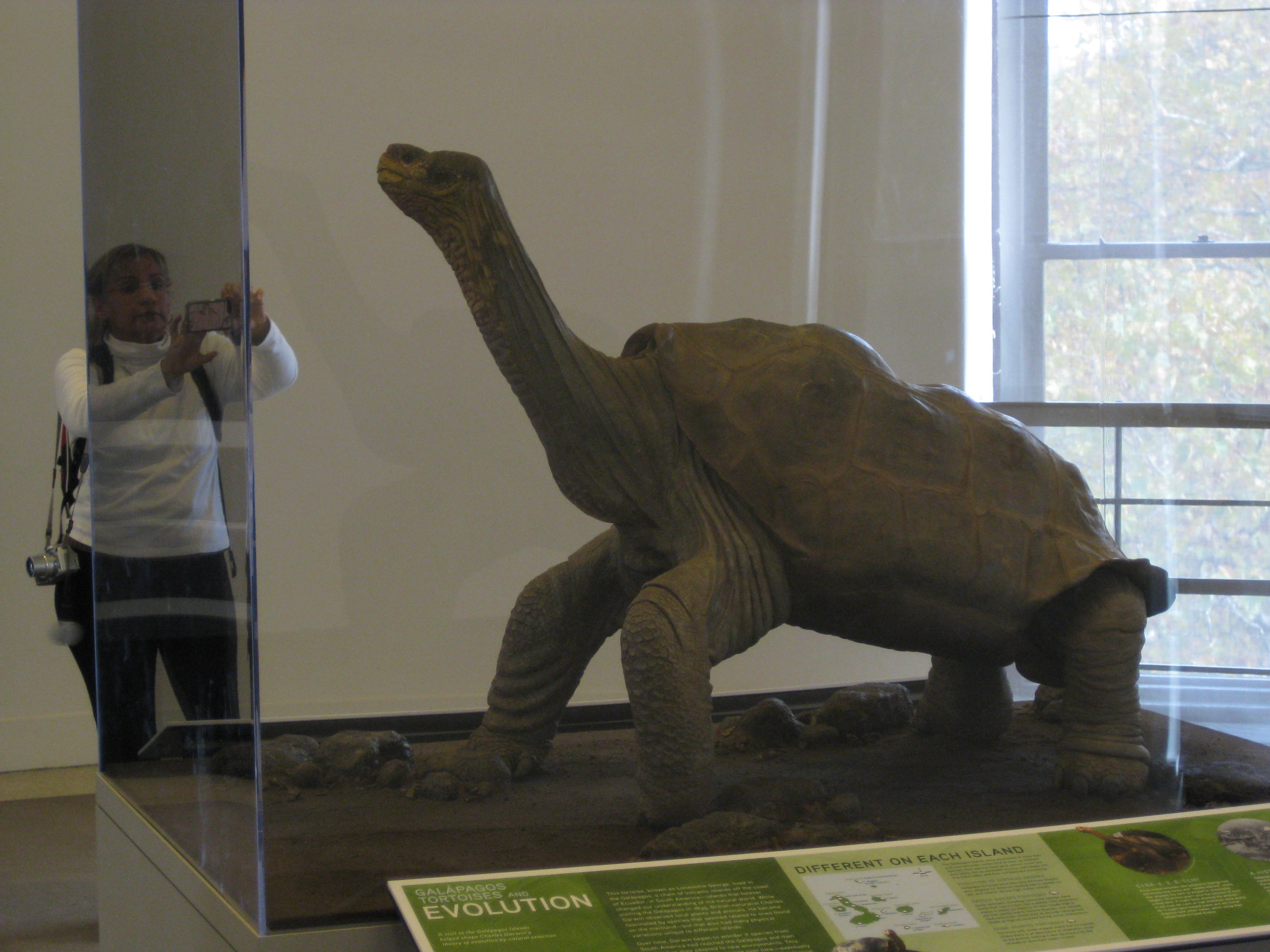
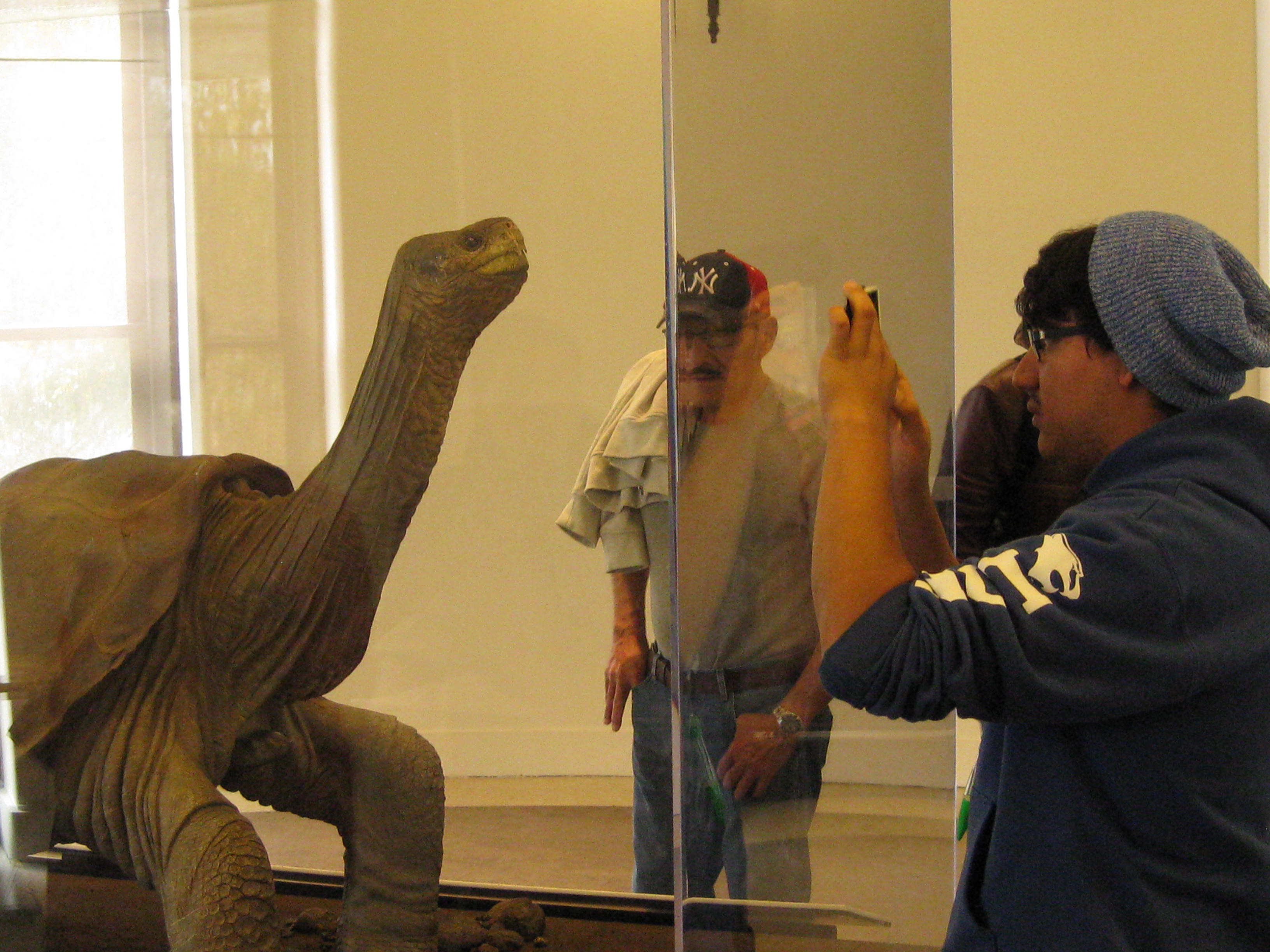
Tu’Malila, a Madagascar radiated tortoise lived with successive generations of the Tongan royal family from 1779 until 1965, after having been brought there by the peripatetic Captain Cook. Jonathan, a giant Seychelles tortoise is still alive at 182 years, exiled like Napoleon, to the distant south Atlantic island of St. Helena. What do these ancients think of us as they observe, through rheumy reptilian eyes, our frenetic comings and goings? We must seem like crazed, bipedal ants, our over-clocked, distractible brains constantly driving us to keep doing things, while they blink and wheeze and munch placidly on soft weeds, noticing perhaps the shift in the angle of the sun as the season progresses or the promise of rain in the great vault of weather boiling high overhead.
Compared to these Methuselahs, Marmaduke is but a spring chicken yet I can’t help wondering how, over our past half century of cohabitation, he thinks about the time passing – or if in fact he even thinks about it! His routine has been remarkably constant: he enjoys basking in the patch of sun that conjures itself up beneath the office skylight at a certain hour in the morning. He tucks into his miniature portion of organic dog food and lettuce leaves with apparent gusto, if the ambient temperature is high enough. There are also his long soaks in his water dish to relieve constipation. That might be fun!
But mostly he just sleeps in one of his several favourite hiding places under my bookshelves. When the house cools down in the winter, these naps can go on for weeks. Being able to remain inactive for long periods confers tangible benefits to turtles, helping them avoid predators, endure inclement weather and interruptions to the food supply. Perhaps these super naps have cognitive benefits too – a pause from too much stimulation, a time to process all they have taken in. Perhaps they meditate Who knows? Perhaps these naps are the way box turtles mark time…
Though his sense of time is opaque to me, I can see that the locations of objects within his operational space seem to matter a great deal. Marmaduke promptly investigates the appearances and disappearances of my knapsack on the floor or any new pile of books or magazines that get put there. Maybe this is evidence of some sort of spatial prioritization, an Umwelt consisting primarily of assemblages of obstacles and hiding places he must negotiate in order to move about efficiently and unobtrusively. Time may have no meaning in such a world, other than the cycles of light and darkness by which objects are illuminated.
As a narcissistic human, I am particularly curious if after all these years Marmaduke has developed any emotional attachment toward me. I’m resigned to the fact that it’s not likely I’ll ever find out. Affection, in the way we humans might understand it, is not something reptiles tend to exhibit, despite this turtle’s entreating use of eye contact when wants to be fed. There is no way of telling what my face even means in his reptilian Umwelt, merely that he has learned that if he stares at it long enough, I will eventually notice him and take care of his needs. In the Venn diagram of our lives, these moments of turtle-initiated communication are where we most overlap. At least it’s something…
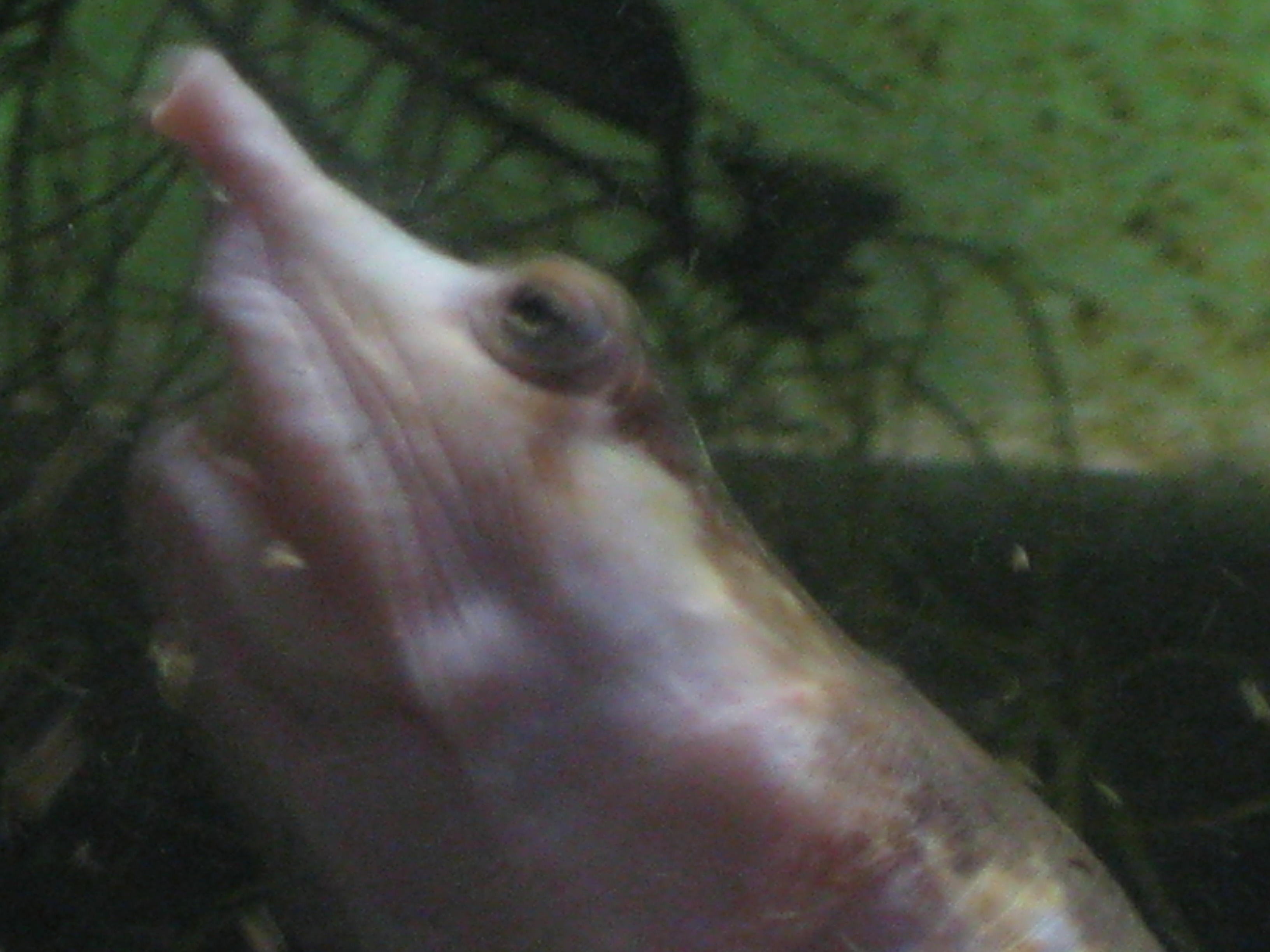
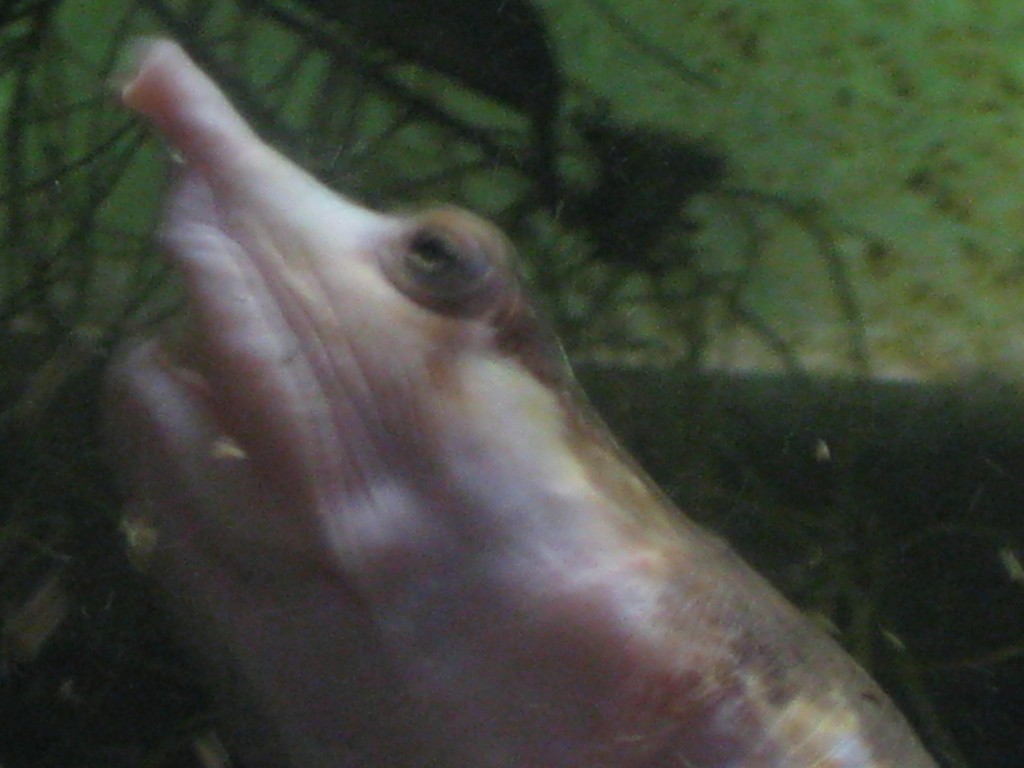 Cousteau in a pensive moment In contrast to their slow-pokey terrestrial cousins, water turtles can seem quick-witted and engaging. Of the freshwater species, the softshell turtles and the similar pig-nosed turtles are the most thoroughly aquatic, gliding through their watery realm with an almost balletic grace. Though I’ve only admired pig-nosed turtles with my face pressed up against the glass of the Berlin Aquarium, I have been living with a pair of soft-shelled turtles, since 1997, having raised them from tiny hatchlings.
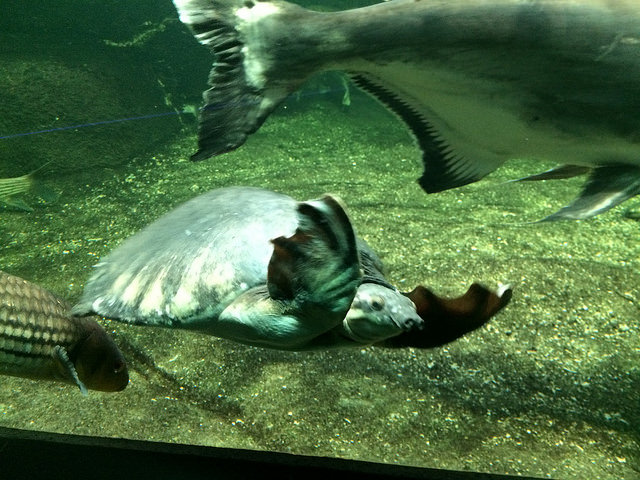 Pig-nosed turtle at Berlin Aquarium To say these creatures are odd is a supreme understatement. Their flexible shells are the texture of wet baseball gloves and they have curious, tube-like snouts, which they employ like snorkels. Temperamentally, softshells are highly idiosyncratic and thus require a fair amount of sensitivity and attention on the part of their keeper, which makes them, it needs to be said, terrible pets, for anyone not willing to devote massive amounts of time to understanding their subtle emotional cues, let alone their physical needs for commodious aquaria with fastidiously filtered, expensively heated water and a carefully chosen substrate in which they will bury themselves for hours at a time, switching over to anal breathing so they don’t have to come up for air.
Cousteau, a female and by far the larger of the two, is a Florida softshell (Apalonia ferox) and neurotic in the extreme. The last time I weighed her, she came in at over 16 pounds and that was some years ago, so the two hundred gallon plexiglass tank of swamp water she inhabits no longer seems as excessive as it once did. Though she could easily amputate a finger with a snap of her wire cutter like jaws, Cousteau is painfully shy and goes into deep conniptions at the slightest departure from her accustomed routine: an unexpected noise, perhaps the clunk of a drinking glass on the coffee table, someone entering or leaving the room too abruptly, or even a play of light on the wall she may suddenly find disturbing. Thus agitated, she will bolt to the far corner of her tank with the back of her shell facing the room to sulk for possibly days before deigning to engage in the world again. She is similarly particular around her meal times, preferring her food pellets to be offered late at night, after midnight ideally, once the overhead lights are dimmed, the television tuned to BBC World News at an appropriately modest volume. And yes, I realize this is weird!
I came to discover these predilections through an arduous process of trial and error. On a couple of occasions, Cousteau put herself on a multi-month hunger strike when the conditions of her confinement were not quite to her liking, coming dangerously close to starving herself. Extreme, suicidal behaviour perhaps, but how else could she get my attention? Despite my having obsessively pored over all the literature I could get my hands on pertaining to softshell turtle biology, Cousteau was not just any softshell turtle, but an individual, steeped in her own enigmatic subjectivity. I had to put myself inside her Umwelt, to see things from her point of view – from the watery vantage point of her big aquarium in the corner of the living room.
Okay, I didn’t exactly climb into the tank with her, but started observing much more closely how she reacted to slight shifts in her living conditions – one variable at a time: the temperature of her water, at what time I was offering her food, the lighting, the ambient level of noise, the sonorousness and timbre of the way I spoke to her, and so on – until she slowly emerged from her deep funk. I live with a very large softshell turtle who prefers to eat late at night, with the television on and I need to talk softly to her while droppoing herring flavoured pellets in front of her tube-like nose. And I’m okay with that.
You know what it is to be born alone,
Baby tortoise!
The first day to heave your feet little by little
from the shell,
Not yet awake,
And remain lapsed on earth,
Not quite alive.
A tiny, fragile, half-animate bean.
To open your tiny beak-mouth, that looks as if
it would never open,
Like some iron door;
To lift the upper hawk-beak from the lower base
And reach your skinny little neck
And take your first bite at some dim bit of
herbage,
Alone, small insect,
Tiny bright-eye,
Slow one.
To take your first solitary bite
And move on your slow, solitary hunt.
Your bright, dark little eye,
Your eye of a dark disturbed night,
Under its slow lid, tiny baby tortoise,
So indomitable.
DH Lawrence: Becoming tortoise.
‘Baby’, a male spiny softshell turtle, inhabits a slightly smaller tank adjacent to the dining room. He is the polar opposite of Cousteau in almost all respects and the closest thing I have ever seen to a ’social’ reptile; constantly solicitous of human attention – a regular life-of-the-party, especially if people are gathered around the dinner table. If he isn’t asleep or hidden under the gravel breathing through his anus, Baby spends his time furiously gesticulating towards the nearest human, his webbed feet performing a kind of frantic semaphore, neck fully extended : Feed me! Feed me! Notice me! Notice me! in the hopes he’ll be tossed a food stick or just hung out with, which he very much seems to enjoy. But why? Obviously he likes being fed, but there seems to be more to it; a kind of intrinsic exuberance that Baby has always had even as a hatchling, no bigger than a quarter. Both Cousteau and Baby came into my life at around about the same time; tiny turtlets only days old; a so-called ‘by-catch’ in a shipment of farm-raised tropical fish. Neither would have experienced much beyond the cosseted interior of the eggs they had so recently slipped out of, maybe bobbing haplessly around in the fish pond for a few days before being scooped up, stuffed into an oxygen injected plastic bag and shipped to an airport. Yet right from the beginning, Cousteau and Baby were utterly different in the way they related to their respective worlds. Far from being ‘simple’ creatures they are –as we all are – individuals.
But must we live isolated within our unbridgeable solitudes? Is our access to animal subjectivity such an existential impossibility or limited to the realm of arcane thought experiment? Perhaps they can really enter our minds and we theirs? Maybe the boundaries between our Umwelten are more permeable, our becoming-animal within reach; dangling like the fibres Deleuze and Guattari envisioned in A Thousand Plateaus, as already connecting us in an enmeshed co-presence.
Perhaps it is a matter of memory. Maybe if we try to remember our animal dreams; the ones that remind us of what it is like to be them, we might be able to become them, at least once in a while.
The philosopher Paulo Virno declares dejà vu a memory of the present. How often have we looked at an animal and felt a deep connection, an overwhelming co-presence in which we briefly are: that cat purring, nestled by the warm hearth, the puppy gambolling in the soft spring grass, the butterfly unfurling its wings, the giant tortoise stoically observing the passage of the centuries through teary, brown eyes, now pausing to nip the petals off a flower?
Animals. We are them. They are us. That is why we like to hang out with them. That is why we should love them even more.
Like a titmouse, which a breeze gently rocks at the end of a sunbeam.
Proust: Remembrance of Things Past
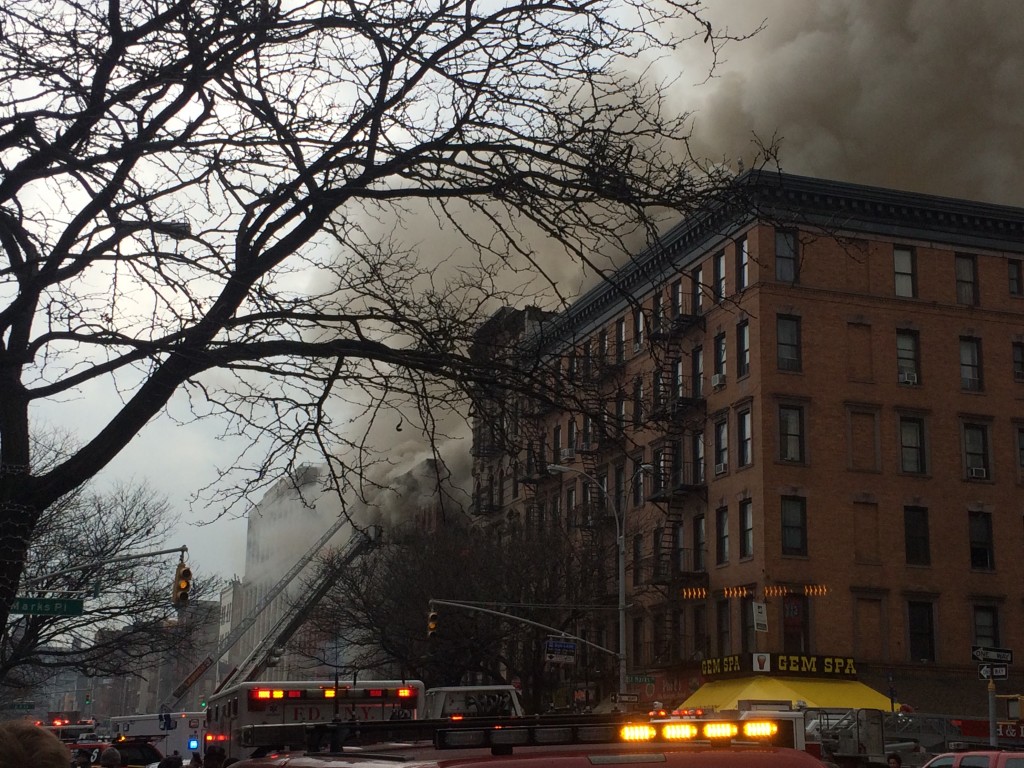
So I was walking westward along East 10th St. early in the afternoon, feeling a little jet-lagged, having just got back to NYC after a month’s stay in Berlin. Moments before I’d said goodbye to Ruth as she boarded the M8 bus on her way to the West Village.
My first day back in a place I’ve been away from for a while can feel fresh and full of possibility, though I noticed that winter had been very slow to release its grip on old NYC this year and the sky was still grey, the trees unpromisingly bare and the sparrows disheveled as they pecked at a pizza crust along the sidewalk. A sudden rumble percussed the air – disconcerting louder than the usual construction noise, the ground shaking. My iPhone buzzed with an incoming text:
Ruth: “Did you hear that?”
Oliver: “Yes I did.”
She calls and tells me the people getting on her bus are talking about some kind of explosion.
“It’s probably nothing,” I said, (as if I knew what I was talking about)
But New York is an incredibly noisy place and one gets used to the din of sirens, pile drivings, and demolition noise that punctuates the background infrasound of thrumming traffic, the vibration of subways and the whoosh of steam conveyed through pipes hidden under the street.
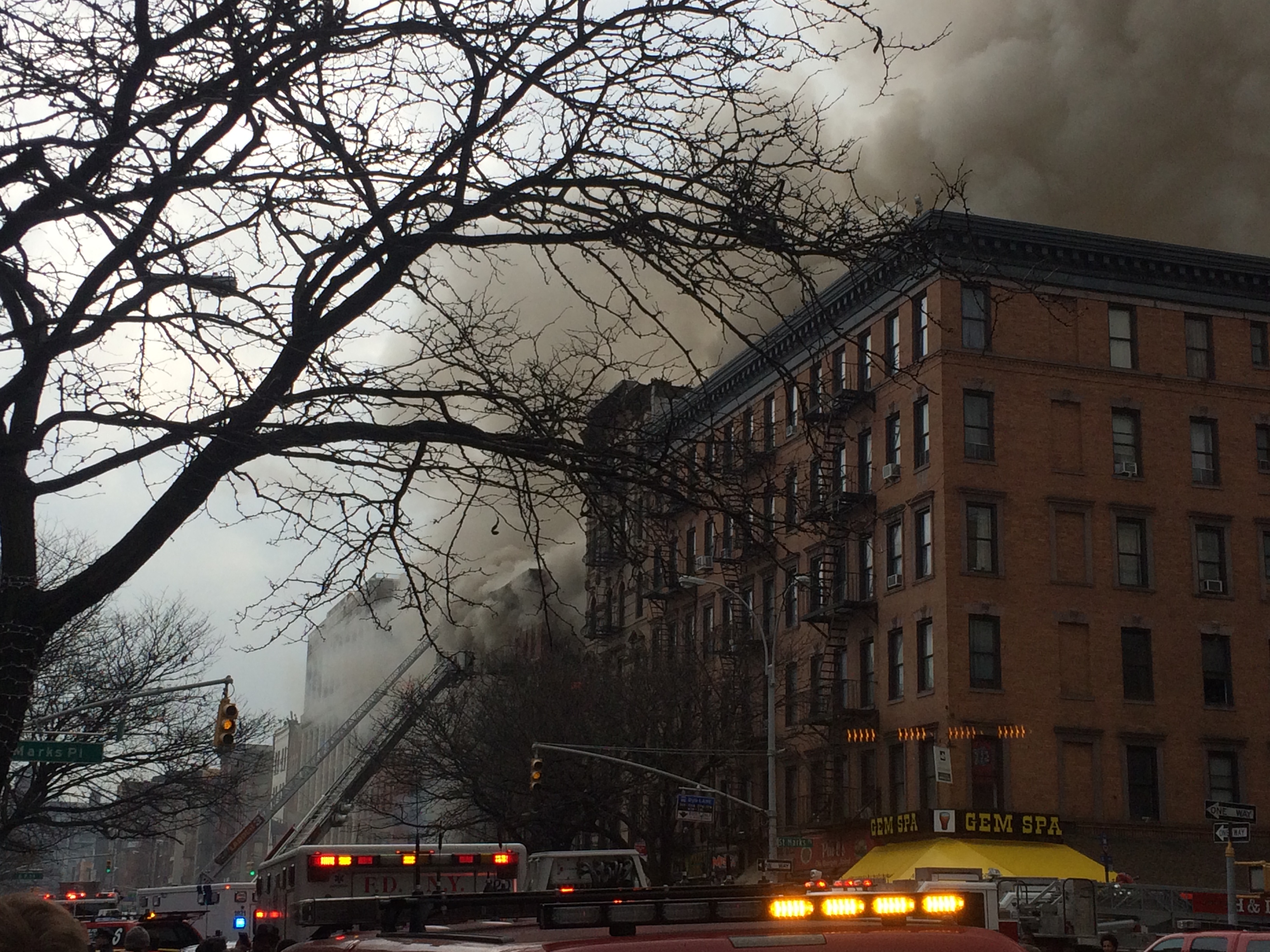
So that was that, I thought and ducked into the barber shop I always go to 2nd Ave, to get a hair cut. It wasn’t busy and I hardly have any hair so it took only a few minutes to restore my stubble and by the time I got out, I could see grey smoke billowing up a short distance down the avenue, just south of the venerable Gem Spa news stand. A crowd had gathered and the first emergency vehicles were rolling in.
There is something horribly magnetic about a fire and I found myself heading toward it without even really thinking; though it was, broadly speaking, on my way home.
The intensity and volume of the smoke was getting worse by the minute and by the time I was a block closer, the fire department had deployed its high ladders and were blasting water from above onto the five story tenement, which by now was almost completely engulfed with the fire spreading to the adjacent. From that point on things moved very quickly, and in a few minutes we were being herded backward from the existing police cordon, at which point the intitial building blew up. It was surreal, horrible and one felt completely helpless knowing that what was happening, what one was seeing at that moment likely involved the loss of life – how could it not? Some of the onlookers were already sobbing or frantically calling or texting loved ones they thought might be in the vicinity and were not yet accounted for.
I exchanged a few words with the long time East Village character, Jim Power, a.k.a. the ‘Mosaic Man’, who had been darting in and out of the chaos on his motorized mobility scooter, sharing bits of news with onlookers and comforting the more obviously stricken. But what does one say in such a situation, other than to communicate one’s concern for the victims, the shock that such a thing has indeed happened; that this unremarkable building, with its sushi place, people’s apartments, their stuff, their lives, a building like so many others, a place that one might have even taken for granted, a mere blip in the optical subconscious–unless of course one lived there, knew people there–had so abruptly been ripped from our midst?
I worked my way eastward, away from the fire scene, looking back at the roiling column of smoke that by now must have visible throughout Lower Manhattan. Everywhere I looked, people had stopped in their tracks. Even five blocks away, knots of people gathered on the street corners, pointing at the sky and shaking their heads; all of us one moment in the midst of our quotidian routines and then presented with the sudden spectacle of disaster. That night the media confirmed what many on the street had been speculating – that the explosion, which cost two lives and injured 22 people was due to illegal modifications to the gas lines in the building. A couple of weeks later I happened to speak with one of the ConEd workers first on the scene and he lamented the criminally shoddy gas-fitting and shared how furious and frightened he was at the many cases of dangerously careless workmanship he so often encounters in his job, and how this continues to put all New Yorkers at grave risk.
During the weeks that followed, as the ruins got pored over by teams of investigators and then proceeded to be gradually demolished, the intersection of 2nd Ave and 7th Street had the air of a grizzly carnival with satellite news trucks jammed into every available niche, television journalists recording their live spots against the backdrop of straining heavy machinery, mounds of simmering rubble and disaster tourists, posing for selfies – the tragic obliteration of half a city block endlessly mirrored in a mis en abyme of Instagram and Twitter updates; its cause, not terrorism as had been feared, but carelessness and callous indifference. And so Manhattan is left with yet another hole, a lacuna, which the forces of turbo-capitalism will soon fill. But with what?
Even without such tragedies, the streetscape of the East Village is changing so rapidly I am almost always in a state of cognitive dissonance, looking for familiar landmarks that have disappeared, seemingly overnight, subsumed by the juggernaut of gentrification. These are ‘micro-worlds’ complete with endemic communities, ways of being, and so many of them are being lost: the affordable mom-and-pop eateries, the Hispanic botanicas, the dive bars, the squats, the bait stores along Houston – even the cars parked on the streets belie a degree of conspicuous wealth that would have been unthinkable but a decade ago. Though still a diverse and vibrant place, the neighbourhood has lost much of its character, its eccentricity, and has morphed into a theme park of its former rough-hewn self. The blogger Jeremiah Moss tracks this steady diminishment in “Jeremiah’s Vanishing New York”, which reads as a chronicle of cultural extinction. But Moss hasn’t given up and is at the vanguard of a resistance movement he calls ‘Save New York’ and he recently instigated a ‘Small Biz Crawl’ to help out vulnerable East Village businesses affected by the fire. But is authenticity, so reified, still authentic, or are have we fallen victim to some idealized nostalgia? The East Village at the dawn of punk rock was a much grittier, more menacing place with ubiquitous crime along with the cheap rents and opportunities for squatting. But it was this set of conditions that allowed a vibrant non-commercial culture to thrive, the fumes of which the East Village is still running on to this day. At some point though, this will be forgotten.
When small establishments close down and are replaced by banks and chain stores, a sense of ‘placelessness’ descends. The likes of Subway, Starbucks and Urban Outfitters are essentially machines, ‘non-places,’ as the critic Marc Augé puts it, interchangeable with others anywhere in the world provided they share the brand. The human interactions occurring within–optimized, efficient and perhaps even affordable, are insipid, anonymous and non-relational and I would argue, contributory to the epidemic of loneliness we are now facing. A sense of allegiance, a feeling of belonging to the local, a culture of identifiable place, is lost when that place becomes just another instantiation of a globalized retail platform. When our every public interaction is imbued with overarching commerciality, we have a recipe for psychological disaster.
In her Guardian essay: ‘The Future of Loneliness,’ Olivia Laing makes the case that the internet, in particular social media, is the ultimate commercialized non-place, where the made-up-ness of one’s on-line persona commodifies personal relationships into ‘likes’ and ‘re-tweets,’ distancing the messiness, the imperfection of the real; resulting, says Laing: “ in being looked at and not seen.” We engage with each other in a state of ‘hyper-anxiety’ – constantly surveilled yet never understood.
Laing goes on to reference the quite excellent ‘Surround Audience’ exhibition now on at the New Museum, which for her epitomizes this anomic, yet narcissistic aesthetic. When I visited the show, the work most literally embodying the sense of pervasive social isolation for me was the series of quarantine chambers designed by the Chinese artist Nadim Abbas, entitled: Chamber 664, 665 and 666, each containing an abject sleeping bunk and some personal effects that can only be contacted through a pair of thick rubber gloves – a metaphor it seems to me, as apt for ebola as it is for Facebook.
That this epidemic of loneliness, this feeling of ‘not being seen’, might have consequences far beyond individual indisposition is what the Marxist critic, Franco ‘Bifo’ Berardi, suggests in his provocative reflections – ‘In the lonely cockpit of our lives’ on the recent Germanwings crash, by now widely believed to have been an intentional act by its co-pilot, Andreas Lubitz. For Berardi, neo-liberal capitalism, with its relentless competition and ubiquitous connectivity, is responsible for us running into the ‘embrace of the black dog’ – the system’s demands have transformed our social lives into ‘a factory of unhappiness of which it appears impossible to escape.’
He goes on to declare:
“(Lubitz) did what he did because he could not get rid of the unhappiness that has been devouring contemporary mankind since advertising began bombing the social brain with mandatory cheerfulness, and digital loneliness has been multiplying the nervous stimulation and encasing the bodies in the cage of the screen, and financial capitalism has been forcing everybody to work more and more time for the miserable salary of precariousness.”
A more extreme form of Berardi’s proposition was foreshadowed, in part violently, in the early 1970’s, by the radical German therapist, Dr. Wolfgang Huber and his Socialist Patient’s Collective, who believed that psychiatric disorders stemmed from the capitalist system and could only be cured by a turn to a Marxist society. Though the therapeutic aspects of Marxism as it has thus far been applied can most charitably be described as ‘mixed,’ the psychological stress engendered as contemporary neo-liberalism subsumes all aspects of our lives into a pervasive, competitive commerciality need to be taken much more seriously. The system’s increasing inhumanity, its emptiness, is clearly driving people crazy yet rarely do we critique its basic legitimacy. Horrific events like the Germanwings crash may well be the symptom, not the disease.
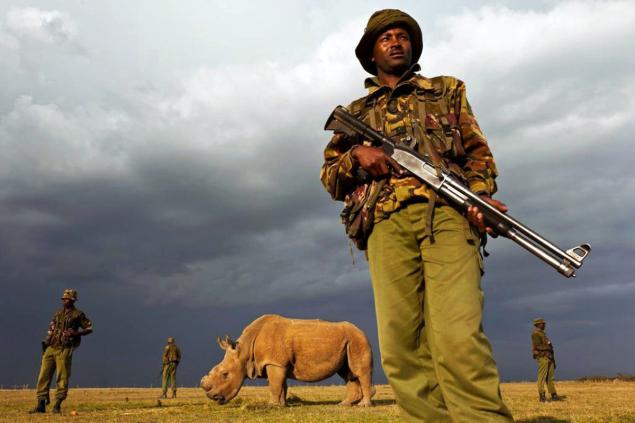 via National Geographic The overwhelming sensation of diminishment in our working lives and in our relationships with each other is compounded in turn by the vertiginously decreasing finitude of the natural world on which our human institutions, our very lives, depend. We are bombarded with heartbreaking images of ending –the last male western white rhinoceros left in the world, with his abbreviated yet still too valuable nub of a horn, encircled in his placid grazing by a full-time phalanx of armed guards, there to protect him from poachers. We’ve reached the point where there is not a single territory on this planet where such a lonely and iconic creature could live out its life outside the market system. So it is doomed to die.
That we are in the midst of an anthropogenic ’Six Extinction’ event is well known and the artist Brandon Ballengée (who I was in a show with at the Media Sanctuary in Troy New York last spring) recently produced a series of works called ‘Frameworks of Absence’ in which he represented the lacunae of extinction quite literally, by cutting the images of extinct creatures out of historical prints and burning them, leaving behind ghostly white absences amid backgrounds depicting their idealized habitats.
With or without extinction, climate change will create absences in what we have once held familiar. Researchers have recently estimated the velocity of climate change in temperate zones to be approximately a meter a day, poleward or upward; meaning that in a given nature reserve, the localities having now the coldest conditions will be hotter than the places that are now the warmest, within a hundred or so years – the mountaintops becoming as hot as the deserts they loom over are now, and so on. This means species requiring specific temperature ranges will have to migrate higher in latitude or altitude to survive, provided there are no barriers to movement, which in the real world is often not the case. Alpine and polar organisms will be particularly vulnerable, as they often already inhabit the extremes of what is topographically possible and will likely run out of accessible places to move – ‘deterritorialized’ literally, into oblivion.
Other species, now at home in more southerly regions, will need to move northward, as their accustomed haunts become uncomfortably hot. In places such as the North American west coast such migration would be impeded by almost insurmountable man-made obstacles in the form of massive cities like San Francisco and Los Angeles, which interrupt the continuum, the cline, of available habitat.
In such cases we might initiate preemptive, ‘assisted’ migrations, which I have investigated over the past years in my ‘Neo-Eocene’ project – a logged-over acreage in coastal British Columbia, where I have planted hundreds of young coast redwood, giant sequoia, walnut and gingko trees, all native to more southerly zones, in anticipation that continuing warming trends will create conditions more favourable to them, and less favourable to the vegetation now considered to be native. So far so good, with the coast redwoods making the most impressive progress, thriving unassisted, almost 1000 kilometres north of their closest native range. The sequoias too are making considerable gains, which is reassuring given the prognosis for their survival in their Sierra Nevada home is increasingly grim, to the extent that by some estimates natural sequoia groves are unlikely to make it through the area’s shift toward permanent drought without artificial irrigation and the construction of fire breaks. Is there not a certain poignancy to the fact that we might only manage to preserve something of the primeval sublime of the sequoia groves through the epic administration of artificiality? But then the climate itself has become a human artifact. We broke it we fix it, I guess, only we can’t fix it, not really, not any more. But absence makes the heart grow fonder. Which makes the Anthropocene the biggest lacuna of them all.
George? Who were you George?
I’m standing beside a plexiglass vitrine at the American Museum of Natural History. In it are the taxidermied remains of George, the last Pinta Island Galapagos tortoise, who died suddenly on June 24th 2012, of so called ‘natural causes.’ At the time of his death, George was estimated to be about 100 years old – a spring chicken by tortoise standards, and sadly he passed away without carrying on his illustrious line. All other members of his Chelonoidis nigra abingdoni subspecies predeceased him, their once considerable numbers decimated by passing sailors who hunted them down as easy to catch and easy to store meat that could be kept alive in the holds of their ships for months. The few Pinta tortoises the sailors missed mostly starved to death after goats got introduced to Pinta in 1959, which then stripped away the vegetation they needed for food and cover. How George survived alone, until he was discovered when he came out of hiding in 1971, is still a bit of a mystery but he was soon shipped off to the Charles Darwin Research Station on nearby Santa Cruz in the hopes he might mate with females of a related subspecies and perhaps sire hybrid offspring to make situation of his genetic extinguishment a little less final. But it was not to be and George during the years of his confinement remained something of a sad curiosity, the embodiment of a ‘zombie species,’ still scrabbling around but already functionally extinct.
When George died in his enclosure, his head pointing poignantly in the direction of his drinking pool, his remains were promptly frozen and shipped off to the AMNH where he was set upon by a crack team of embalmers, who (it has to be said) did an amazing job making them look almost perky. The AMNH produced an informative video documenting the taxidermist’s macabre prestidigitations; the agonizing decision making of choosing the appropriate pose, getting the correct drape of his wrinkly skin right, the touchings up with paints and varnishes, the fastidious attention to detail neccessitating even splotches of authentic Galapagos dust to be daubed onto George’s eviscerated carapace.
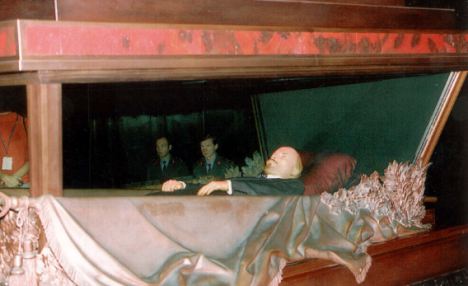 Lenin In his temporary mausoleum in the museum’s Astor Turret, George draws quite a crowd and he rather gives the impression of a reptilian Lenin, serene beneath the glass of his tomb, while crowds of supplicants stream by to pay their respects or merely snap a selfie or two while standing next to what was after all ‘the last of his kind.’ Other than a striking similarity in head shape, both lonesome George and Vladimir Ilyich shared the quality of becoming even more iconic after death, more laden with gravitas, their formaldehyde and wax-infused corpses the recipients of both veneration and revisionist history – George the last survivor of an imagined, prelapsarian, South Sea eden; Lenin the last ‘authentic’ Bolshevik.
The preservation of corpses, whether through taxidermy, embalming, or ritual mummification, seeks to reframe the life of the deceased into an idealized, one could say fetishized state; the gory circumstances of the death, the bleeding bullet holes torn through the flanks of the game animal before its final agonized collapse, the sunken flesh of the terminally ill patient after a long confinement, all cleverly obscured to make them look as they were in life, or rather, as they should have been according to the aesthetic agendas of their posthumous manipulators. Whether it be a valued hunting trophy or the body of a notable lying in state, what we are dealing with here is the grammar of propaganda and we should see it for what it is.
Lenin for instance appears as if he is rather beatifically following the whispers of his visitors from just under the lightest of naps, a fatherly figure enjoying a well-earned rest after finally putting things right with the world. Our tortoise George is displayed with an eagerly outstretched neck and custom-made eyes, beady and enthusiastic, as if he were about to embark on some pleasant chelonian journey, to a parallel universe perhaps where females of his kind still exist and the unpleasant finality of his extinction no longer needs to be contemplated. Though I won’t get into specifics of Lenin’s multifarious legacy, I’m not going out on a limb to say he’d have more than a little to account for if he ever woke up from that satin lined coffin of his. As for George, his carefully posed death puppet of a body has been spun by the AMNH and the Galapagos Conservancy, not as a symbol of our abject failure to preserve threatened fauna (which by some estimates we are losing at a rate of 140,000 species per year) but as an icon of high-minded wild life conservationism.
While I am all for a ‘glass half full’ outlook (and there have been some encouraging recent gains regarding Galapagos tortoise breeding), the AMNH’s attempt to transform poor dead George into a crowd-pleasing, feel good, story is one symptom of the museum’s larger initiative to revise their kill em’ and stuff em’ legacy into something more palatable to the contemporary metropolitan audience. It is of course laudable that the museum is now a ‘force for the good’ and active in world-wide efforts at conservation; a leader in the research of global biodiversity, but by papering over its extensive and enthusiastic record of ’collecting,’ that is to say, killing of scores of rare animals to create its famous, crowd-pleasing displays, we are deprived of an opportunity to learn from the institution’s history and to celebrate how far attitudes have generally come.
Let us look at the history of one of the AMNH’s iconic assets, the Akeley Hall of African Animals, a veritable temple of dioramas, each representing a major ecosystems of the continent. The centrepiece is an entire herd of elephants, massacred specifically for the display and arranged on a plinth what is described as an ‘alarm formation.’ Among them are a mother and calf shot by none other than Theodore Roosevelt and his son Kermit, who were actually over in Africa shooting elephants for AMNH’s rival, the Smithsonian but they generously bagged a couple of extra for their friends in New York, who after all needed a lot of them for their imposing composition and anyway, one gets the impression they were kind of on a roll. Even by the standards of the early 20th century, there would have been little scientific justification for this carnage and the herd of elephants frozen in mid outrage had a lot more to do with creating a spectacle than advancing any frontiers of zoological knowledge. These days we might more rightly regard this abomination as a reminder of the cruelty, barbarism and entitlement of the self-styled Great White Hunters of times gone by, a regrettable monument to what happens when colonialist privilege meets excess testosterone. And yet the AMNH makes no obvious effort to explicate or contextualize any of this. Their messaging to museum-going children is still that: ‘dead elephants are cool!’
The bulk of the hall is taken up by the dioramas proper, exquisitely painted tromp-l’oeil backdrops of arid, acacia studded plains and seething, hyper-vegetated rain forests in front of which naturalistic groupings of dead animals have been placed – rhinos wallowing in mud, apes clinging to jungly vines with adorable infants suckling at their breasts, antelopes of all shapes and sizes, big cats, giraffes, and just about any other creature one might expect to be found prowling, galloping or climbing through the idealized environs of a primeval Africa.
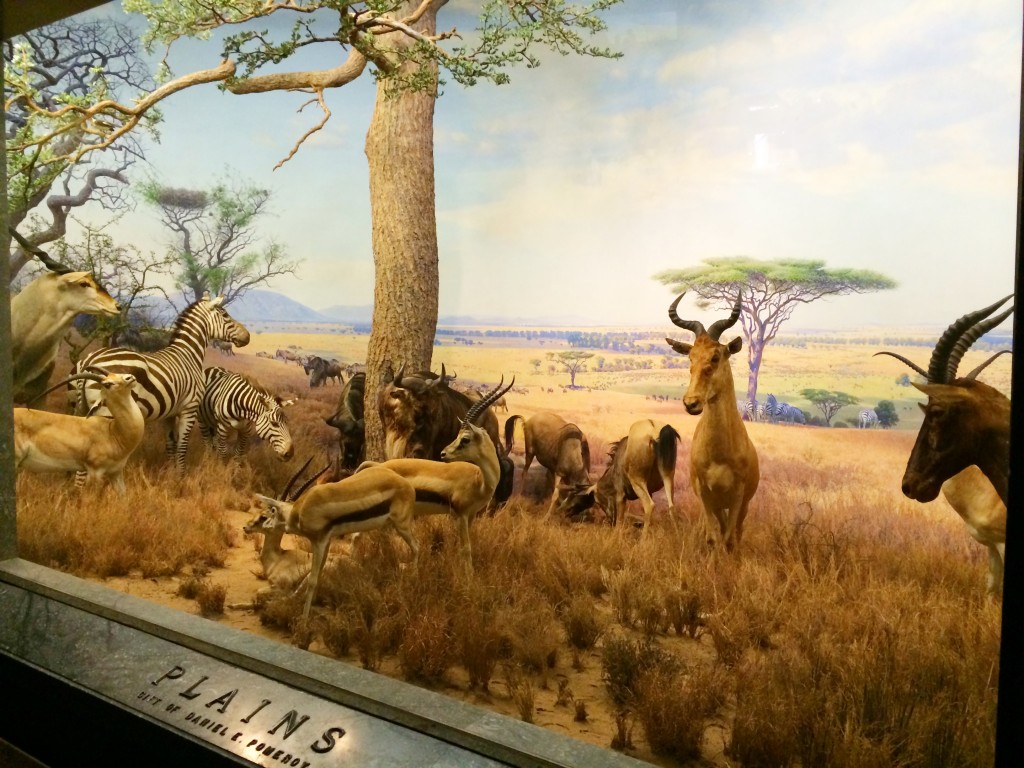
What the museum consciously underplays here is that these beguiling displays celebrate not only Africa’s once manifold biodiversity, but an entirely different aesthetic–a competitive materialism on the part of First World collectors, who in their fetishization of the exotic, spent considerable sums tracking down and killing some of the rarest, most elusive creatures on the planet to bring back as publicly exhibited trophies (let’s call them what they are) and to not so subtly underscore the power relationship between American empire and what was even then an increasingly subjugated global ’wild,’ a disappearing frontier of primeval ecosystems in the midst of colonialist exploitation. The dioramas, with their illusion of intimacy exist within the dissonance of us thinking that somewhere out there is still the possibility of an Eden while at the same time knowing that what is in front of us is an arrangement of dead skins propped up on armatures of wood wool and mothballs.
The not so subtle message of the AMNH’s dioramas is:
’ Nothing is beyond the reach of our guns,’
(or perhaps:)
‘To the victor – the spoils!’
 Sumatran Rhinos By the time the museum’s Hall of Asian Animals was being set up by Colonel John Faunthorpe and Arthur Vernay, a wealthy, British-born, New York antiques dealer, some animals such as the Sumatran rhinoceros and Asiatic lion were already going extinct in their native habitats and much was made of the lengths Vernay had to go through, the many appeals and entreaties he had to make to get the hunting permits needed to kill still more of them for his displays.
Was it all for a good cause, this science-minded collecting of critically endangered animals such as the mother Sumatran rhinoceros, shot along with her little calf for the edification of Gotham’s discerning, museum-going public? From a present day perspective, their dark little diorama seems particularly sad, a testament to a completionist obsession, the acquisition of rhinoceroses as if they were hockey cards or Royal Doulton figurines, regardless of the precariousness of the animals’ status in the wild; in fact spurred on by their tantalizing scarcity.
There is no doubt that in the past the demand from museums seeking rarities hastened the extinction of more than a few species and it would be helpful for our understanding of changing attitudes if the AMNH would take it upon themselves to highlight this dark side of their collection building. To be fair, this acquisitiveness was the norm for most natural history museums of the 19th and early 20th centuries, in both the public and private spheres. They weren’t always the bastions of wildlife conservation they now promote themselves as. While valuable taxonomic understanding can indeed be gleaned from specimens killed in the field, the slaughter of whole herds of elephants and entire rookeries of seabirds – even the nestlings peeled from their delicate skins to be stuffed and varnished– could never have been justified as ‘science’ even by the standards of the day. These are circus sideshows we should rightly view them as archaic, even vulgar. Though the Halls of African and Asian animals can perhaps be reconsidered as historic monuments to the quaint but also cruel attitudes of a bygone age, the museum’s media hoopla around their taxidermification of poor, dead George, seems anachronistic to say the least. We learn very little from a dead Galapagos tortoise, no matter how cleverly he is mounted. George now exists as an art-directed ‘thing,’ optimized to look the way we expect him to and no longer a ‘being,’ with his own agency and life world. We screwed up and he went extinct. No amount of paint and fibreglass will change that tragic fact.
The Sea and the Desert is a chapter in Henry David Thoreau’s chronicle of his extensive ‘sojourning’ around Cape Cod in the 1860’s.
We might think of rising sea levels and creeping desertification as uniquely contemporary symptoms of anthropogenic climate change but Thoreau noticed them way back in his day, recording with his characteristic eye for detail, a great many meteorological, ecological and human phenomena that together create the shifting territory of the thing we call ‘the Cape.’
This desert extends from the extremity of the Cape, through Provincetown into Truro, and many a time as we were traversing it we were reminded of “Riley’s Narrative” of his captivity in the sands of Arabia, notwithstanding the cold. …. In one place we saw numerous dead tops of trees projecting through the otherwise uninterrupted desert, where, as we afterward learned, thirty or forty years before a flourishing forest had stood, and now, as the trees were laid bare from year to year, the inhabitants cut off their tops for fuel.
Though Cape Cod has been in a state of constant flux ever since it was first bulldozed into place by the glaciers of the last ice age, there is a certain poignancy to its more recent, post-colonial history, as one of the first landfalls of European incursion into North America. The successive human waves that broke upon its shores left their own layers of deposition–the accumulated strata of hopes, ambitions and failures are embedded all over the landscape, if one knows where to look.
Thoreau encapsulated the protean quality of the Cape so beautifully:
The sea-shore is a sort of neutral ground, a most advantageous point from which to contemplate this world. It is even a trivial place. The waves forever rolling to the land are too far-travelled and untamable to be familiar. Creeping along the endless beach amid the sun-squall and the foam, it occurs to us that we, too, are the product of sea-slime.
It is a wild, rank place, and there is no flattery in it. Strewn with crabs, horse-shoes, and razor-clams, and whatever the sea casts up,—a vast morgue, where famished dogs may range in packs, and crows come daily to glean the pittance which the tide leaves them. The carcasses of men and beasts together lie stately up upon its shelf, rotting and bleaching in the sun and waves, and each tide turns them in their beds, and tucks fresh sand under them. There is naked Nature, inhumanly sincere, wasting no thought on man, nibbling at the cliffy shore where gulls wheel amid the spray.
There is still a seething, hissing quality about the place; a sort of fragility too, as if all the quaint human infrastructure, the architectural bric-a-brac of National Seashore information kiosks, the tourist shops and thriving gay bars of Provincetown, the upscale beach houses and black-topped roads could all be washed away with the slightest turning in the weather.
Given my interest in disturbance ecologies, I was thrilled to be offered an artist’s residency at one of the Cape’s oldest houses, at a place called Phats Valley near the town of Truro. I was joined there by my friends and collaborators, Liz Ellsworth and Jamie Kruse of the New School, whose artistic practice focuses primarily on matters geologic and the study of deep time, and who both have had a long term aesthetic engagement with the landscape and culture of the Cape.
We set ourselves a mission of a contemplative nature: to endeavour to capture something of the essence of our locality in its current, Anthropocenic, moment; to attune ourselves to its ephemerality by simply walking, pausing and observing. Our inspiration was the 17th century Japanese poet Bāsho, who set set out on a five-month journey, documented in his poetic chronicle: Narrow Road to the Interior. While traveling, Bashō drew upon and modified the traditionally collaborative haiku practice known as renga, which incorporates sensations of place, events and allusions to literature, history and myth. Renga, in its most basic form, is written by multiple authors who link their verses, building upon each other’s words under the inspiration of the environmental and social contexts of the moment (the trees in bloom, the stage of the moon, and who else is present at the renga party.) At its best renga embodies the impermanence, the ‘this-ness,’ of an instant in time.
Deleuze gave (this) ‘this-ness’ a name, calling it haecceity, from the Latin ‘to behold.’
A season a winter, a summer, an hour, a date have a perfect individuality lacking nothing, even though this individuality is different from that of a thing or a subject. They are haecceities in the sense that they consist entirely of relations of movement and rest between molecules or particles, capacities to affect and to be affected.
A Thousand Plateaus: Capitalism and Schizophrenia (with Felix Guattari)
With the inspiration of Thoreau and Bāsho to guide us, Liz, Jamie and I set out under the great blue vault of a magnificent late summer sky to begin what the theorist Jane Bennett refers to as microvisioning, in reference to the way Thoreau practiced his art of engaged observation and deep attention–not an overly probing or systematic scrutiny–but rather more of a perceptual wandering; a seeing without preoccupied looking.
Go not to the object; let it come to you…
(Thoreau’s Journal 4:351)
From our base at the verge of time and space on the margin of Phats Valley’s picturesque salt marsh, we sojourned to various nearby localities, making a daily practice of easing into our immersive awareness, starting our sessions with conversation and tea before we delved into contemplative observation and ultimately, the generation of the renga stanzas. These take the format of (5,7,5,7,7) syllables. .
(5, 7, 5,7,7)
My gaze it returns
To dying rays of sunshine
A vulture circling
In an otherwise empty
Blue anthropocenic sky
(For example)
Liz and Jamie’s long-standing relationship with the Cape complimented my situation of never having been there before, and writing together gave us the chance to meld our sensibilities and subjectivities, our responses to the environment and the material conditions we encountered; both in the perfect individuality of the moment and in the larger geologic and historic frameworks where these moments seem to float. I had just been at the massive (600,000 person strong) People’s Climate March in New York City–a watershed moment in the public acknowledgement that something ought to be done–but what did it all mean? Through renga, I hoped I might get a little closer to some kind of understanding
Our daily practice evolved as a kind of meta-narrative, a record of our pausings, when we made the time to observe and acknowledge the this-ness of a given moment within the multiplicity, or white hiss, of all the other moments, extending through space and time.
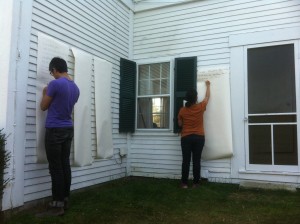
We ended our residency with a public renga writing party and shared a lovely afternoon with a group of intrepid poets, who composed the renga with us on large rolls of paper, tacked to the outside walls of the historic Phats Valley headquarters. The whole event is nicely documented here on Liz and Jamie’s blog. Thanks in particular should be given to the residency coordinators Ann Chen and Davey Field of the Nomadic Department of the Interior, who made our residency possible. The house, dating back to the American Revolution, has been in Davey’s family since the early 1960’s and staying there was truly a delight, though when I first walked in, about to spend the night in it alone, I could sense there was some kind of ghost or other (palpable though not visible) presence sharing my abode. As is my custom, I introduced myself to the empty yet somehow electrically charged air of one of the attic bedrooms, and from that point on a cosseting calmness descended and I was able to sleep most soundly. Ghosts very much need to be acknowledged I think, and might appreciate a certain degree of politeness. After all, who knows what it might be like for them having to put up with us clattering around like boors in the overlapping domains of our reality?
Be it the accumulated spirits of the deceased inhabitants or the drifts of plastic waste piling up on its beaches, Cape Cod is all about layers. It is a shifting palimpsest that appears to will itself into being; reconstituting itself out of the products of its own decomposition and perpetually reemerging as the new Cape, out of the shifting, drifting sediments of the old. With its vitality, agency and interconnectivity to the deep, swirling cycles of geology and weather, Cape Cod is truly a hyperobject.
In order to engage such an ephemeral subject at a given instant, we thought it helpful to embrace Thoreau’s concept of ‘incomplete learning,’ an experience akin to what one feels when starting a foreign language, when the sounds and meanings are not yet clear and still largely perceived as an undifferentiated continuum–with the inherent capacity to startle, yet without being subsumed into the banality of explicated meaning.
‘Not until we have lost the world do we begin to find ourselves’
(Thoreau, Walden 171)
Jane Bennett makes reference to this non-judgemental, rather Zen-like practice of observation, in her 2002 ‘Thoreau’s Nature: Ethics, Politics in the Wild,’ where she builds a convincing case for his surprisingly post-modernist tendencies.
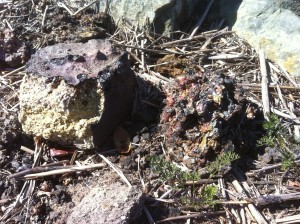 mineraloids The Phats Valley house and its immediate environs exist as a kind of microcosm for the cycles of ebb and flow, erosion and sedimentation that so define the ‘Cape-ness’ of the Cape. The salt marsh is bisected by an artificial ithmus– the abandoned causeway of the Cape Cod railway, now the domain of sombre pitch pines and scraggly sumachs. In its rubble, I found anthropocenic mineraloids– fragments of slag, coke and brick constituting the geologic stratum of a once thriving Steam Age civilization that existed here during the 19th century. The quaint house, archetypical Americana, with its prim clapboard and gnarled, rustling trees, now seems a world away from the spectre of machinery. The long driveway floods during the higher tides, adding to the sense of splendid isolation.
Yet the view from the front door, which now looks out over an olive-coloured expanse of soughing cord grass and wheeling marsh birds, was once very different; the railway passed by just a few feet away, and I can imagine the chugging, clanging locomotives vibrating the windows of the parlour, backlighting the curtains with a roiling orange glow as they pulled their squealing train cars on into the magnetism of their destination.
That is all long gone now of course–another layer obscured by more recent sediment, continually accreting. The topmost strata is unmistakable in that it contains massive inclusions of discarded plastic, the most ubiquitous material of our age. In the relatively short time of its existence, plastic has spread throughout the biosphere, substantial parts of which, particularly in marine environments, can now legitimately be called the plastisphere, as organisms have already adapted to the problematic material by colonizing it and breaking it down into an even greater multiplicity of substances potentially harmful to man. Indeed, Plastics “R” Us!, as water-soluble plastic chemicals like bisphenol A (BPA) and flame retardants already circulate in all of our bloodstreams.
At Phats, the plastisphere is most visible in the zone of flotsam deposited at the high tide line. Plastic dominates this territory in a surprising variety of material expressions, creating an overall aesthetic experience that borders on the beautiful or the repulsive, depending on what frame of mind one is in. I include some photos of these happenstance assemblages at the start of this post.
Poking around those drifts of discarded polypropylene, polyethylene, styrene, vinyl, polycarbonate and nylon, I wondered what will form the stratum of the next geologic age? Will it be the ashes of human extinction that mark the dawn of the post-human, the way the K-T boundary delineates the quick and brutal end of the dinosaurs? Or will we be someday heralding the age of the neo-human, having somehow morphed into a species with greater sensitivity to the material realities of the planet on which we evolved.
Whatever will come next?
Whoever?
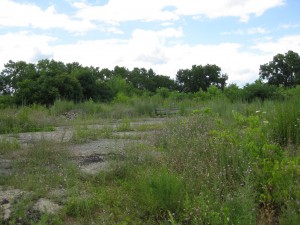 North Troy NY brownfield savanna
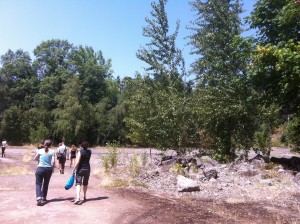 safari into the Williamette Cove brownfields
Those of who call ourselves ‘environmentalists’ have a tendency to imagine a prelapsarian wilderness that once was pristine and then became progressively defiled and diminished through the carelessness of humankind. But the earth had been through many environmental catastrophes long before we came along– though this doesn’t exactly excuse us from our manifold sins. The infamous Chixculub asteroid impact suddenly ended the long reign of the dinosaurs and the more insidious yet equally catastrophic evolution of photosynthesis deep within the cells of certain cyanobacteria contaminated the earth’s early biosphere with oxygen– a fatal poison to the majority of organisms present at the time, resulting in what is now known as the oxygen catastrophe, a mass die-off of the earth’s biodiversity and a climate change event that froze the planet in the longest snowball earth episode in geologic history.
What is unique in the present (Anthropocenic) moment is that we know we are causing a massive and likely suicidal ecological crisis and yet choose not to do anything about it. Here we are at the tail end of 2014 with atmospheric CO2 levels higher than they’ve been for 800,000 years and the 6th mass extinction accelerating to the point where the earth has lost half of its wildlife species in the past 40 years. Political leaders, particularly those of oil rich countries like my native Canada either willfully ignore the scientific consensus or in the most egregious cases, (again Canada), actively censor the findings of scientists and even weather forecasters. Because a little knowledge can be a dangerous thing. Or is it?
In a recent video, Žižek makes the perhaps startling case that there is considerable poetry in our present situation, that is to say, our disavowal, our state of knowing that something is true and yet acting as if it wasn’t. He argues that to “truly love the world, we must love its imperfections,” including, presumably, the ones for which we are directly responsible. “In trash,” he declares “is the true love of the world,” a sentiment similarly observed by a Zen priest in the masterful little documentary, Tokyo Waka, which explores the world of Tokyo’s ubiquitous and trash loving crows. To be more precise the priest observes: “In trash is the residue of desire,” a sentiment perhaps less direct but still elevating garbage to a kind of reified affection.
To follow that logic, when an entire landscape becomes trashed, it should be particularly worthy of our love and it was in this spirit that I embarked upon my summer explorations…
But first some background: The Superfund was originally set up in the America in 1980 to identify and facilitate the cleaning up of the country’s most hazardous waste sites. In theory this might have created sufficient funding and legislative willpower to deal with this dangerous and unhealthy problem but between partisan politics and bureaucratic ineptitude, implementation fell far short of what was needed.
Though most people would want steer clear of toxic wastelands, I wanted to see if there were any adaptive ecological processes operating there that might be transforming these zones of exclusion into useable habitats. I had the strong sense that conventional ecologists and environmentalists might be missing something very important, that nature was capable of doing an end run around our destruction, if only we would get out of the way. My summer safari took me to sites on both sides of the continent–Troy, NY and Portland, Oregon–and what I observed there gave me some hope and insight into nature’s surprising ability to colonize the messes we have left behind.
I was invited to Troy by my pal Kathy High for a collaborative investigation into the area’s extensive brownfields. Once known as the ‘collar city’ for its shirt, collar and textile production, Troy is considered the birthplace (and graveyard?) of the American industrial revolution. A fortuitous confluence of rivers made it possible for early factories to harness abundant mechanical (and eventually hydroelectric) power as well as to cheaply transport products and raw materials. Like so much of America’s industrial heartland, the area has suffered from economic decline and many of its once thrumming factories lie in ruin in within highly contaminated terrain.
Some of the worst sites are situated along the banks of the picturesque Hudson River, which transitions here from tidal to freshwater, the end of a long estuary. Downstream, all of the Hudson is classed as a Superfund site because of extensive contamination by PCBs, a potent carcinogen, dumped for decades by the General Electric Corporation as a byproduct of manufacturing transformers and other electrical components. PCB’s are a persistent organic pollutant (POP) that bioaccumulate in the river’s fish, making many species unsafe to eat–including the reputedly delicious striped bass that spawns nearby at the junction of the Hudson and Mohawk rivers.
 chimney swifts over North Troy Despite being a very degraded ecosystem Troy’s former industrial landsa are full of surprises. As part of a summer youth program, I led a ‘bio blitz’ of a community garden that had been established on a brownfield site near the Sanctuary for Independent Media. It wasn’t long before we found a magnificent stag beetle hiding in the rotting stump of an (invasive! exotic!) Ailanthus tree. High overhead, chimney swifts traced their invisible arabesques into the topaz air of the summer evening. This species, has long adapted to human presence and as indicated by its common name, makes its nests in disused chimneys. The chimney swift is a close relative of the Vaux’s swift, which puts up a spectacular display every evening as great clouds of the birds funnel into in a large chimney at the Chapman School in Portland, Oregon.
A local Troy resident told me she had recently found red-backed salamanders under debris in her backyard yard, situated quite near some of city’s most contaminated industrial sites, with nothing that might be deemed ‘intact’ woodland anywhere in the vicinity. With the sharp decline of amphibians worldwide, even in protected national parks, it might seem surprising to find them surviving in such anthropogenically disturbed habitats but this is consistent with findings in the UK where rare newts and other amphibians as well as lizards, slow-worms and grass snakes make their last stands in these unprepossessing environs, among the trash, eroding pavements and ruined buildings. In fact brownfields turn out to be far more suitable habitat for these delicate little creatures than is the intensively managed agricultural landscape that has obliterated large tracts of Europes’s biologically diverse ‘Kulturlandschaft’.
 stag beetle in Ailanthus stump At a Superfund site at the foot of Troy’s Ingalls Ave, I watched turkey vultures soar over an edenic looking mosaic of meadowy expanses that have cloaked the heavily contaminated soil. These neo-savannahs are punctuated by lush groves–a botanical mosh pit of weedy natives like box elder, black locust and cottonwood mixed in with exotic Ailanthus and Paulownia. All of this is gloriously unmanaged, left to its own rampancy, and though the species constituting this habitat are largely considered ‘invasive,’ they embody a new kind of ecological becoming, their novel juxtapositionings and processes of succession–a ‘Nature 2.0′ in the making.
If we put aside our purist bias, we might celebrate brownfields as territories of regeneration and marvel at how they adapt to the disturbances and wastes we leave in our wake. One might even regard them as ‘wilderness’ of a certain kind as they are one of the few ecological realms we have let slip from our control–leaving them free to reconfigure themselves and follow independent trajectories of neo-evolution.
 Troy NY’s future brownfield rangers The collapse of industry though, leaves more than just picturesque ruins and novel habitat in its wake. For human communities,‘Detroitization’ means decaying infrastructure, diminished economic opportunity and the adverse health effects of pervasive chemical contamination. If sufficiently de-toxified, these lands can be rehabilitated as perfectly reasonable urban nature parks (see my previous posting on Berlin’s Templehof airport) but the challenge is to do so without diminishing their often surprising biodiversity.
Troy might be an ideal location for a Brownfields National Park, where local youth could work as ‘brownfield rangers,’ leading tours of the area’s ecological and historical heritage as well as doing field studies and cataloging the species to be found there. Though this necessitates a change of perspective in what we North Americans typically think of as a ‘natural’ park experience, it is high time we open our minds to such opportunities. Brownfields are the future. Brownfields are us!
Over on the other side of the continent, I met up with artist Marina Zurkow in Portland, Oregon. Together, we led artistic incursions into a Superfund site on the edge of the Williamette River. We explored first by water, using a flotilla of kayaks peopled by an intrepid collection of individuals who responded to our call for participation in what (to the less adventurous) might have seemed an arcane enterprise. We conceived our expedition as a kind of group imagination exercise and christened it -“IF YOU SEE IT–BE IT!” in the spirit of the biosemiotician Jacob Von Uexküll, who did such groundbreaking research on the spatio-temporal worlds of animals, which he termed the ‘Umwelt.’ Aboard our tiny craft, we collectively tried to imagine/channel what it might have been like to navigate the contaminated and disturbed riparian environment from an animal’s point of view (water striders, otters, sturgeons, etc.) – inhabiting (in our mind’s eye) their biosemiotic state, ‘becoming’ them, as it were, in a collective thought exercise.
Marina’s long term plan is to construct a raft-like roving laboratory she calls the Floating Studio for Dark Ecology, on which artists and researchers ply the river, exploring its narratives of contamination and recovery as well as disseminating practices of contemplation and engagement between its human and non-human communities.
Our early evening voyage proved suitably anthropocenic: a bald eagle gliding through the shimmering cottonwoods of Ross Island–a section of river whose bed is being continually scoured by heavy gravel mining machinery–the blue tarp and scrap lumber bricolage of homeless encampments festooning the banks of the Williamette–the third world within the first world, the metabolic waste of neoliberal capitalism as it eats its way through our material reality.
 Neo-ecologies of Williamette Cove Once again there were fascinating and new ecological assemblage in these zones of dereliction and abandonment. Washed up on the industrial shore of a former shipyard–exquisite hydrozoans of a type I have never seen before:
 hydrozoan The brownfields of the former factory site at Williamette Cove, though dangerously contaminated with heavy metals, wood preservatives and organic pollutants, proved not so ‘brown’ after all and were resplendent with novel botanical groupings–neo-succession! Native species like Arbutus menziesii (Madrone) formed habitat groupings with such hardy exotics as Paulownia tomentosa (princess or empress Tree) and Crataegus monogyna (European hawthorn). It is thought the empress trees made their original landfall in North America via their fluffy seeds, once used as a packing material for porcelain and other fragile goods originating in China and Japan. A gust of wind and an open crate at the dockside and their botanical colonization of the continent would have been begun.
In addition to brownfield neo-ecologies there is a parallel and equally fascinating neo-geology emerging from the material detritus of our age. Mineralogically, these are mostly composites and conglomerates or pyrolized residues of industrial processes such as coke and slag, as well as ceramics that have been fired into the form of brick, tile and pipe, much of it broken up into rubble. This so-called ‘urbanite’ is dominated by concrete and ferro-cement in various states of decay and petrochemically based asphalt and asphalt concrete, widely used in paving.
Sometimes though, a geologic object occurs that is of more obscure though still clearly anthropogenic provenance. At Williamette Cove, we came upon an exquisite specimen–a fossil of sorts–consisting of a fused mass of ribbed metal fragments, the armouring of industrial electrical cable, set within a matrix of a more indeterminate material, which might have been partially incinerated plastic. Perhaps this mystery mineral was formed when some itinerant metal collector tried to salvage copper wire by throwing scrounged cable into a campfire to melt off its rubber insulation and loosen the metal cladding. I may never discover this exquisite object’s true origin and it might well become the topic of frenzied conjecture to some future archeologist, wondering what our experience was like as we drifted deeper into the fraught and turbulent horizon of our anthropocenic future.
 neo-geological form
 zone of alienation
 zone of regeneration
In Tarkovsky’s 1979 film Stalker, a mysterious guide leads a couple of characters known only as ‘the writer’ and the ‘professor’ into a post industrial ‘zone of alienation’ where it is promised one’s innermost wishes can be granted and where the rules of physics no longer apply. The ‘Zone’ is completely abject, a place of weeds, broken machinery and the ruins of factories and yet it is hauntingly beautiful in a way that is triggered (perhaps) by our deep yet unconscious familiarity with such landscapes –the places Walter Benjamin called the optical subconscious, the quotidian zones in which we are so fully at home we don’t even realize we live there.
These aren’t the iconic, aspirational landscapes of snow-capped mountains, palm fringed coral beaches and glittering urban skylines –the stuff of screen savers and photo murals in tacky restaurants, but rather the prosaic localities we continuously experience, perceiving them peripherally, from the corners of our eyes yet rarely explicitly acknowledging. The French term ‘terrain vague’ comes closest to the way these places feel and they might take the form of a trash-strewn railway embankment or an abandoned car park with rank vegetation coming up through the broken pavement or perhaps one of those forlorn, zones of contamination we refer to as brownfields, which have become the global hallmark of industrial decline.
I think back on my Amtrak journeys through the rust belt of America, marvelling at the Piranesian grandeur of once opulent railway stations left to crumble at the trackside, the ruined vaults now sheltering only birds which dart in and out of the shattered arrays of windows. The train keeps chugging lethargically (it is Amtrak after all, itself a symbol of decline in American technological ambition) through dour, neglected expanses, prosaic, ugly, endless –you can’t really call it ‘countryside’ exactly– but for the occasional scruffy woodlot and oily wetland which passes between the wrecking yards, quonset huts and derelict factories. This is (as Deleuze might call it) a ‘striated’ landscape that interleaves the decaying residue of a once prosperous age of material production with a resurgent, weedy nature –an ecology of discard, a ‘zone of alienation’ where anything might appear– a muddy field strewn with bone white shards of dishes and upturned toilet bowls, the twisted wreckage of a carnival rides left over from, what? A tornado? Perhaps, even–though I did not experience it–the fulfillment of one’s deepest wishes…
But is this not the state of the world as we all now know it? It’s the Anthropocene, baby, and collectively we’ve chewed up every inch of biosphere; extirpating, contaminating and cultivating ourselves into this, the global ‘Nature 2.0’ reality, where even the unfolding of weather and the chemistry of the oceans have become extensions, artifacts of human existence. So past the point of no return are we that we might as well discard nostalgic notions of ‘wilderness’ and adopt a new, Anthropocenic grammar, already envisioned by the likes of Žižek and Morton, which more aptly describes the hybridized, pervasively humanized environment in which we now live.
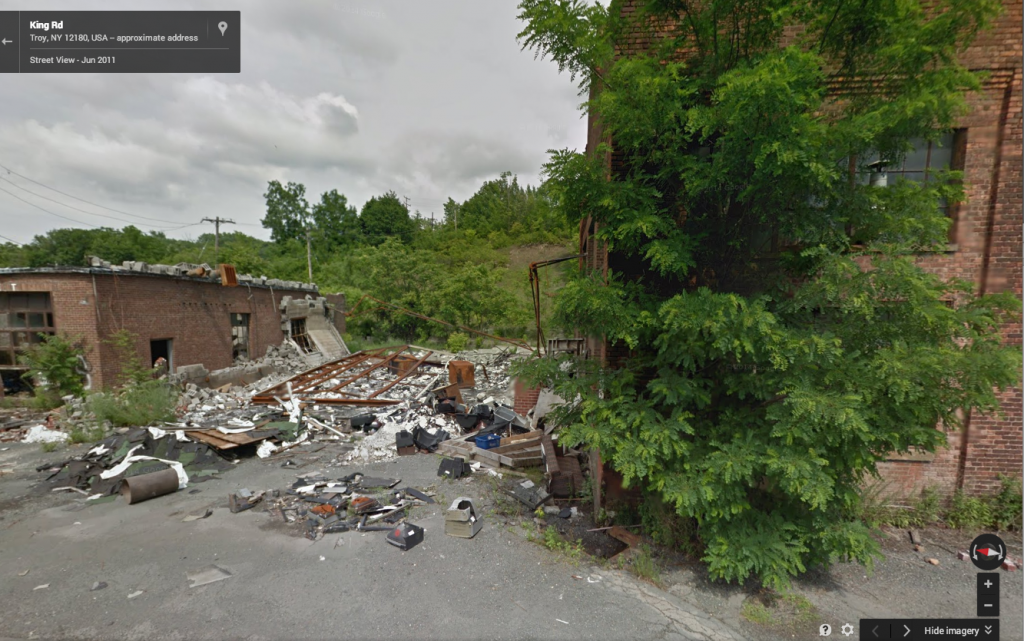 terrain vague Our planet has essentially become one, big ruderal ecology (from the Latin ‘rudus’ meaning rubble), characterized by the large-scale extinction of species–passenger pigeons, big cats, rhinos–as well as entire ecosystems–Madagascar, the Arctic, coral reefs. And yet there is a curious, parallel process of adaptive evolution occurring in the disturbance ecologies and debris fields (called anthromes) we leave in our wake.
At Chernobyl (one of the greatest ecological and social messes we have ever been responsible for, a byword for lethal, irreparable contamination and epic technological failure) some bird species–and by no means all of them, as many kinds there have significantly declined–but certain bird species seem to be surviving by evolving a tendency to produce more cancer-fighting antioxidants which help resist the effects of the pervasive radiation. Scientists are calling this “unnatural selection” and it is already driving evolutionary change.
 canid hyperorganism In much of eastern North America, the wolf was largely wiped out during European colonization but it has recently come back not as a wolf exactly, but a kind of hyperorganism–a three way hybrid between wolf, dog and coyote that pushes the boundaries of what it even means to be a species. With the precipitous decline of the ancestral wolf, an ‘eye of the needle’ effect ensued in which wolf genetics became more ‘soluble,’ more open to other singularities and contagions, a necessary precondition for the evolution of a new, protean canid, able to prosper in the niche now available for some canny predator able to exploit the pervasively humanized and ecologically degraded environment of second growth forest and exurban sprawl–the kind of places that are an anathema to the so-called ‘pure’ wolves of the primeval wilderness but which offer abundant prey resources of lawn-fed deer and genetically moronic pets. Enter the ‘Coywolf’ or Eastern coyote. They might be a product of ‘unnatural’ selection, but they sure are hungry!
Such novel recombining is occurring at a multi-species level too, with entirely new hyperecologies evolving as weedy, native species commingle with invasive exotics, all of them jostling and repositioning themselves into configurations that never would have existed ‘naturally’ but which now comprises recognizable and widespread landscapes of brownfield savannah and emergent, wasteland forest that are found throughout the world in pretty much any place we have exploited and then turned our back on. Many of these organisms are the hardy cosmopolitan nomads we are all used to seeing, such as tree of heaven (also known as the ’garbage palm’), black locust, pigeons and rats, but perhaps surprisingly these unprepossessing assemblages can support a diverse array of other species, some exceedingly rare, which hail from habitats like gravelly steam banks and dry heaths now largely obliterated from a hinterland dominated by chemical intensive farming and vast, ecologically sterile acreages of housing developments and big box stores.
In the UK, where humanized landscapes are particularly well studied, it is estimated that up to 15% of the nationally rare insects and spiders are dependent on brownfields for their survival as do several species of reptiles, orchids and other rare plants.
I was delighted last March to visit the grounds of the now disused Templehof Airport in Berlin, which as a result of citizen pressure has been set aside as a kind of publicly accessible ruderal ecology park. Here one is greeted by the incongruous site of windsurfers careening along miles of abandoned runways while skylarks hover high over vast swathes of tawny grassland, singing and establishing territory in their annual rite of spring.
Along with a surprising diversity of meadow dependent birds – wheatears, shrikes, whinchats and so on, 236 bee and wasp species have been recorded on the grounds, more than 40 of them endangered or near extinction, particularly those dependent on the open, sandy microhabitats that have all but vanished in the over-managed environs of the countryside.
 gestapo prison excavations
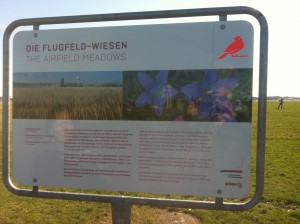 airfield meadows
This wonderful interleaving, this striation, this ‘to-ing and fro-ing’, between architectural ruin and ecological renewal is to my mind a tremendously optimistic model for the future of parks in general and for our appreciation of landscape as a whole and it is in promoting this aesthetic that Berlin is very much at the fore. The Templehof park doesn’t try to paper over its problematic Nazi past but lets us grapple with it by preserving the forbidding Fascist architecture and letting us watch archeological excavations of Gestapo prisons and slave labour camps taking place on on its grounds.
At the same time we are offered profound hope by witnessing innate processes of ecological and cultural regeneration get encouraged, not in an over-planned or commercialized way, but from the ground up, in a way that is distinct from the banal, generic late capitalist aesthetic that so frequently defines urban renewal initiatives elsewhere. By being leaving it alone, Templehof is able to renew itself.
Though the global ecological crisis is deep and inestimably tragic, we can perhaps allow ourselves to cautious celebrate the evolution of a new kind of nature, a ruderal nature, where kestrels soar across the heat haze of abandoned runways that are slowly becoming encrusted with lichens and grasses and where rare wild flowers can find a toehold among the rubble of some of history’s worst crimes against humanity. The sky is filled with the coloured sails of paragliders and a bumblebee is making its first foray into the vast warm vault of another spring.
 sailing the runways
 skylarks nest here
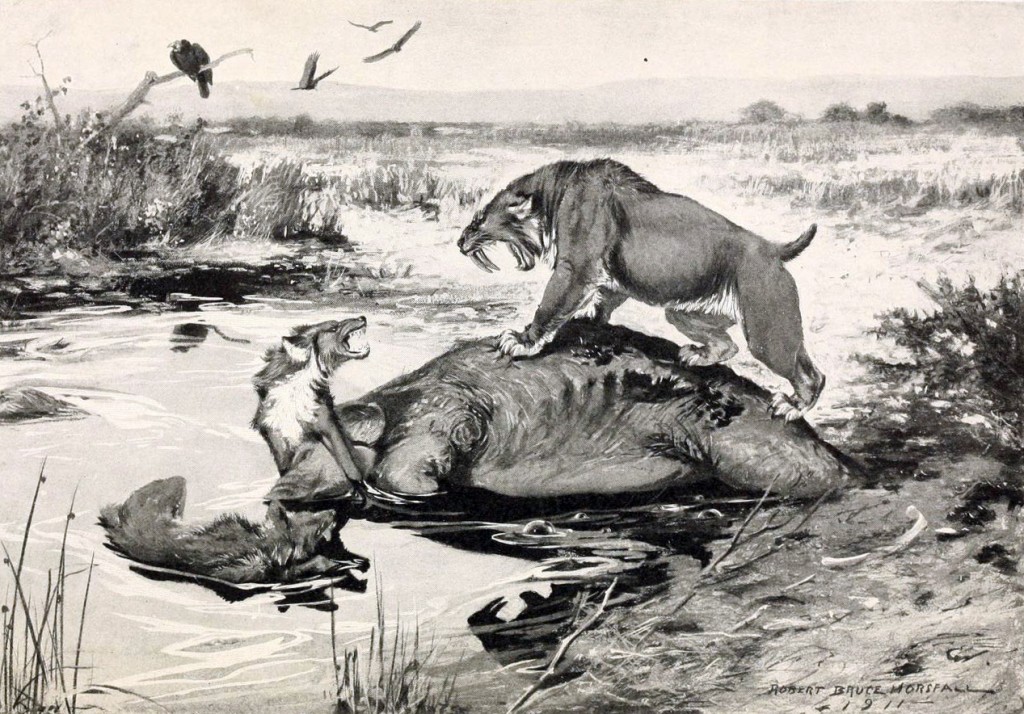 where it all went down… The great blue bowl of the California sky has doubtlessly presided over some strange affairs, but perhaps none is stranger than the serial cycle of entrapment and petrification that started around 38,000 years ago in a collection of deceptively limpid ponds in what is now a quiet park in downtown Los Angeles. After it rains here, the play of sunlight and clouds is mirrored on their lambent surfaces, beneath which lies a menacing secret: for what first might appear to be a refreshing pool in an arid terrain is only a thin film of water obscuring an abyss of sticky bitumen, which has been oozing steadily from petroleum-bearing rock formations deep beneath the earth.
These are the notorious La Brea Tar Pits and since the days of the Pleistocene their peculiar configuration has served as both death trap and mausoleum for thousands of creatures–great and small, thirsty and merely curious–who venture into them and get stuck in their viscous pitch. Like a giant version of the ‘cockroach motel,’ once they ‘check in’ they never ‘check out’ and indeed the thrashing and bellowing of trapped victims attracts predators, whose natural wariness proves no match for the promise of an easy meal, ensuring they too are quickly doomed after jumping in for the kill. And so for thousands of years, whole conglomerations, entire food chains of animals have met their ends here: predators and prey sinking down alongside each other, each creature naïvely repeating the fatal mistakes of its predecessor: sabre-toothed cats and Dire wolves, with fangs and claws sunk into the contorted bodies of mastodons and camels, all of them frozen in elemental struggle as if in some Classical frieze. Not even the carrion eaters escaped the gruesome fate. Outsized vultures, giant condors and hideous, meat-eating storks, wheeling and squabbling for landing rights on the bloated corpses and almost corpses, snagged themselves when a carelessly extended talon or trailing pinion made contact with the merciless tar, that pulled them in, flapping and screeching , never to fly again. As well as being deadly, the tar has miraculous powers of preservation. The seething, interconnected beds of bone that have accumulated there have kept scientists busy ever since they first started excavating back in the early 1900s. Many of the rich paleontological finds are on display at the adjacent George C. Page Museum.
When I was a boy in Toronto back in the early 1960s, a small piece of the La Brea Tar Pits was on display in a dusty diorama at the city’s Royal Ontario Museum. This was a few years before the ROM adopted the loathsome trend for ’interactivity’, which consigned much of the museum’s extensive palaeontology collection to back rooms, out of public view, and what we got instead was an ersatz mishmash of mood lighting, audio tape loops and fibreglass models of dinosaurs standing aura-less amid plastic palm trees. Anyway before all that stupidity, I remember how transfixed I was ‘just looking’ at the thing itself, without being told how to think about what was in front of me – the tea coloured skeleton of a sabre-toothed cat, its outsized canines filigreed with tiny age cracks, poised to stab the neck of a hapless ungulate (a proto-camel? an extinct horse?) which had already begun to sink. It was the futility of it I remember the most, that both animals died together in the same inescapable way, the first doomed by thirst (or bovine idiocy), the second by carnivorous savagery. And I knew this scenario was to play itself out again and again because it was elementally and inherently unavoidable. Presiding over the sad scene was a tromp-l’oeil painted backdrop of a clot of vultures, hanging like wind-ripped umbrellas in the branches of a skeletal tree, and in broad brush strokes, a distant herd of mammoths melting into the horizon.
When I finally, this spring, got to tour the La Brea tar pits firsthand, I couldn’t help but see them as a kind of trope for contemporary times.
LA is a strange enough place to begin with–its palm-studded freeways and rivers of twinkling windshields pouring into the heat haze of the hyper- illuminated horizon–a place at once banal and startling, the High Baroque of American drive-thru suburbia amid scintillating beaches flooded in a golden, Canaletto-esque light. There are people there, of a certain age, whose faces have been so surgically altered it is as if they’ve been sucked through a magic wind tunnel. The mismatch between their wrinkle-less heads and the sun-withered bodies is chimerical, as if bands of Surrealist ‘exquisite corpses’ had gone AWOL, pulling themselves off the canvases and walking around. Los Angeles is the very essence of the American Anthropocene and yet prehistory bubbles and belches everywhere just beneath the surface. The city sits astride a massive oil field, where serried ranks of mini malls and tract homes lie nestled in the napes of brown hills and rustling eucalyptus groves, the edges of which bleed into a kind of terrain vague of ponderously nodding pump jacks tirelessly sucking petroleum out of a deposit dating back to the Miocene– a geologic epoch already long gone by the time the first mammoths sank into the tar.
Wandering through the pleasant grounds of Hancock Park, the past becomes the present and one soon encounters a pair of giant, chocolate-coloured ground sloths, like outsized Easter confections, placid and dim-witted in expression, yet armed with menacing fore claws that could easily rip the face off almost any attacker. As late as 10,000 years ago, these ungainly beasts lumbered across what was a vast North American range – their remains having been found from the Yukon to Mexico. At La Brea, they were regular victims to the suffocating tar.
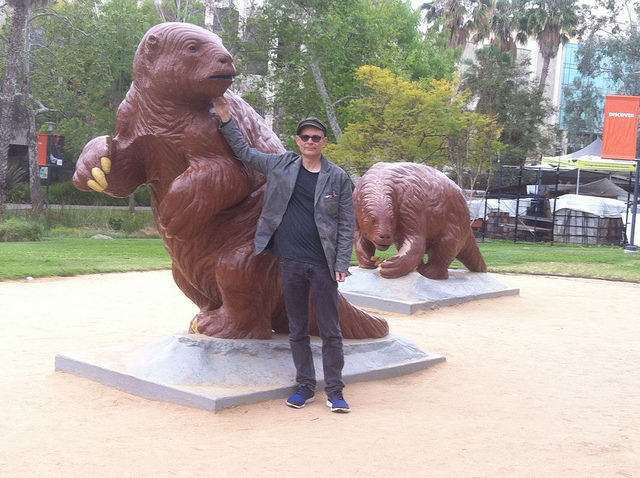 yours truly and the ground sloths
In a still bubbling tar pit encircled by construction fencing, a family replica of gigantic Columbian mammoths replays a pathetic tableau. An adult is hopelessly stuck in the pit, its mouth agape in panic, its trunk frozen between the great curved brackets of its tusks, frantically gesturing to its mate and calf who stand helplessly on shore. The theme of serial entrapment and the futility of instinct gets amplified as soon as one enters the museum, which is packed with reconstructed skeletons and glass cases full of phylogenetically arranged remains, memorializing the legions of hapless creatures who died there over thousands of years, who just couldn’t stop themselves from making the same fatal mistakes over and over, in a senseless and recurring cruelty against which no benevolent god or Walt Disney narrator would intervene to warn ‘Stay out of those pits, yo!’ If only Spielberg had been in charge…
In paleontological terms, the tar pits are what is known as an ‘evolutionary trap.’ These create a stimulus that certain species are unable to resist and the results are often fatal. A contemporary equivalent has been the sad epidemic of dying albatrosses we’ve been seeing on Pacific Islands, their body cavities packed with bits of plastic that they seem programmed to snatch up from the waves and swallow in place of their natural food. Like the victims of La Brea, they just can’t help themselves.
Back at the Tar Pits, the Dire wolf (Canis dirus) seems to have been a particularly slow learner. To date the remains of over four thousand of them have been found there with doubtless many more to come. One of the more impressive displays at the George C. Page is a long, back-lit display, like something out of a high-end shoe store, containing hundreds of Dire wolf skulls, each an embodiment of one individual’s lack of impulse control. It seems that whenever a pack of them came upon an animal in distress in the tar, they would pile right on in on top of it, dooming themselves by their own overly developed killer instincts and susceptibility to peer pressure. The fact that the Dire wolf seems to have been exceptionally competitive, didn’t help matters. Males in areas where there was high population density developed outsized fangs with which to fight each other. It’s hard not to imagine the pack dynamic being a rather savage affair, especially when they chanced upon a bleating animal, trapped in tar. For the Dire wolf, there likely wasn’t a lot of time for second guesses. Though heavier and likely much meaner than their little cousin the coyote (Canis latrans), the Dire wolf failed to survive the Pleistocene, while the coyote still thrives in LA’s hills and canyons, feeding on what it finds in trash cans and snatching up unguarded pets. Though the Tar Pits weren’t the only factor in the Dire wolf’s continent-wide extinction, the evidence of its behaviour at La Brea indicates an inherent inflexibility, which must have been a major handicap in what, at the end of the Pleistocene, was a rapidly shifting set of conditions including changes in climate and the incursion of the first Paleo-Indians into its environment, who competed aggressively with the wolf for prey.
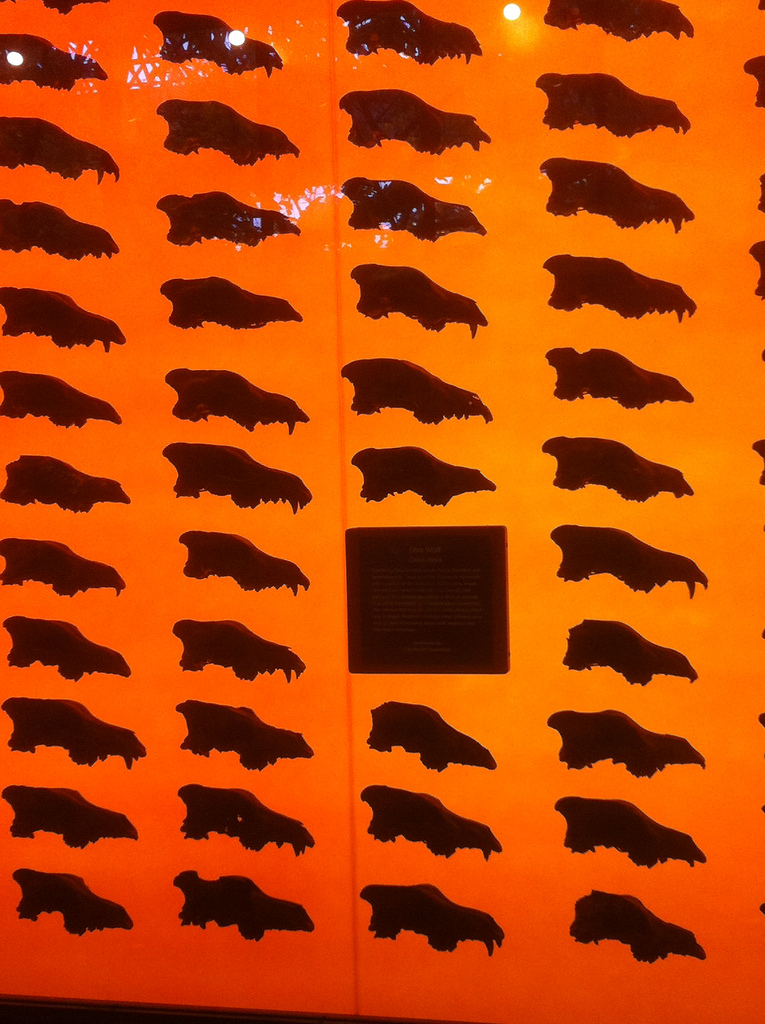 dire wolf skulls Though we may think our species’ ability to show foresight gives us particular resiliency–after all we started out in minuscule numbers, survived an Ice Age and proceeded to take over the world–we find ourselves now under a similar delusion to that which befell those hapless beasts at La Brea. Could it be that in the black, viscous materiality of petroleum we have finally met our match? Though we may think we have mastery over our fate, we seem blind to the possibility that it might be a substance that has control over us…
As an evolutionary trap– a nemesis–petroleum is the perfect agent. It is the very essence of death, a distillate of corpses from untold myriads of prehistoric organisms, which has quietly waited for us beneath the earth. If substances possess their own agency, as Jane Bennett surmises in her (2010) Vibrant Matter, is it so far-fetched to suggest that petroleum is luring us in, manipulating our innate behavioural vulnerabilities to ultimately absorb us into its oozing corpus? Like the sabre-toothed cat and Dire wolf before us, petroleum has exerted its ability to hypnotize, to communicate directly with our vulnerable animality, bypassing our much vaunted capacity for reason and discernment. It’s not that big a leap from the Tar Pits to the Tar Sands…
As happened to the Pleistocene creatures who got stuck in it when they put aside their caution, petroleum–ever protean– has set its exquisite trap for us in the form of a fata morgana, which gives us the illusion of eternally abundant and convenient energy with no long-term consequences. We are probably already in too deep to realize what has happened; that we are becoming petroleum, absorbed by the wily substance to become one with its subterranean deposits.
The Anthropocene might be remembered as a geologically brief period during which our species was allowed an overdraft, a blip during which we extracted a quantity of the black ooze before we had to repay our loan with the highest of interest; our lives, and those of the countless other organisms we took with us after we have made the planet uninhabitable. In so doing, we are offering up billions of putrefying corpses, untold tonnage of petrochemical garbage and entire landscapes of withered vegetation to be re-incorporated into the geologic, where unstoppable tectonic regimes will reprocess it into the mother of all oil fields.
So it is a mistake perhaps to wax too moralistic about our failure to rein in our natural impulsivity, to plan sensibly or imagine a future free from our addiction to this substance. Our connection to it might be too deep, too genetically encoded for us to resist through mere self critique.
Following the logic of the Dire wolf, our own species is competing increasingly viciously for what is (for the geologic moment anyway) a limited resource. The power elites in localities dependent primarily on petroleum production (Russia, Nigeria, Libya and others) have drawn whole societies into animality and impulsivity.
Even Canada, long a role model for liberal democracy, has slid into this petro-brutality. Under the prime ministership of oil-mad Stephen Harper, its government has declared a totalitarian war on scientists who study climate change and associated environmental contamination. The uncomfortable facts they keep bringing up highlight Canada’s abysmal record on these matters, which, aside from being an international embarrassment, threaten to push the usually complacent Canadians into a confrontation with the ecological Real (boring!, depressing!), invoking questions the Harper government is determined not to let us ask. Important and long-standing research facilities and environmental monitoring stations have already been shuttered, their scientists sacked and the scholarly material packed away or even thrown into the garbage. Those few scientists still working have been given STASI style minders, through which all communication with the public must be vetted. They even shadow the scientists at academic conferences to make sure they don’t say anything deemed ‘off message’ to the government’s single-minded agenda.
Yet given that our attraction to petroleum is demonstrably biological, can we really blame the individual oil worker, warlord or myopic Canadian bureaucrat? By doing their part to hasten mass extinction, they are in the service of the long term interest of petroleum itself. By extending its sticky tendrils through a higher dimensional space than most of us are letting ourselves imagine, petroleum assumes the characteristics of what the philosopher Timothy Morton calls a ‘hyperobject,’ an entire set of relationships, interactions agencies and desires of which we are but a small and transient part.
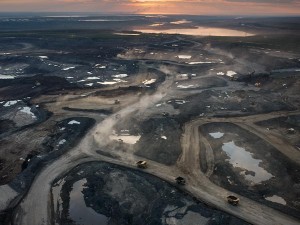 tar sands (via National Geographic)
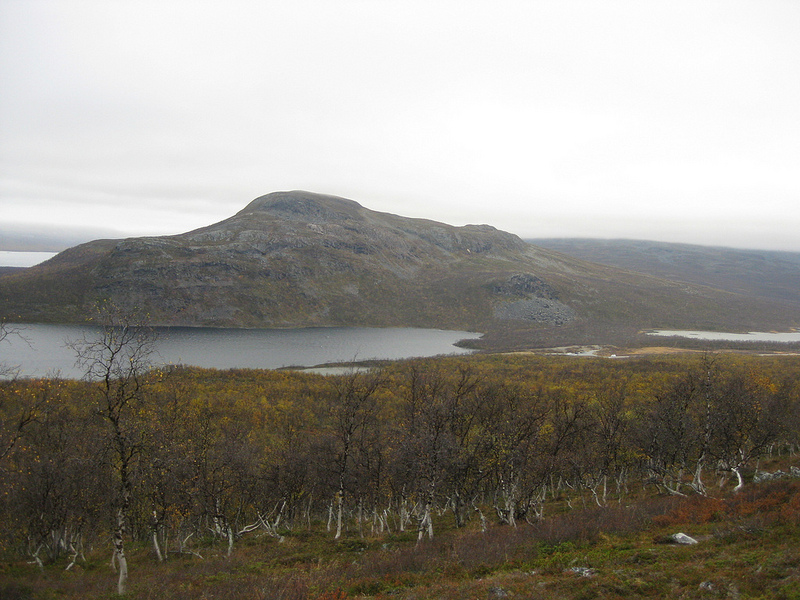 dwarf birches and tundra 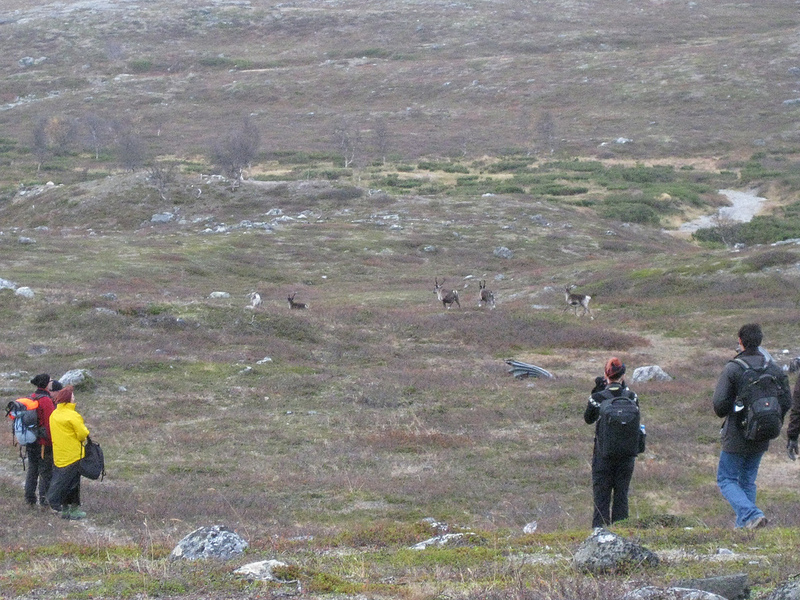 suddenly – reindeer!
The morning broke grey and brooding outside the Kilpisjärvi Biological Station and after a quick breakfast, we were on the trail, hiking up Saana Fjell, guided by Erich Berger of the Finnish Bioart Society. The idea was to familiarize ourselves with the geology, ecology and cultural history of the vicinity so we could dive into our research plans as soon as possible.
The Australian bio-hacker, Oron Catts had already been here for a week to do some scouting for his group’s ‘Journey to the Post-Anthropogenic’ project. They planned to perform a comprehensive bio-archeological survey of the crash site of a German Junkers 88 bomber that came down on Saana in 1942, which included a metagenomic analysis of the plane’s debris field and a recreation of the crash trajectory using a remote-controlled drone.
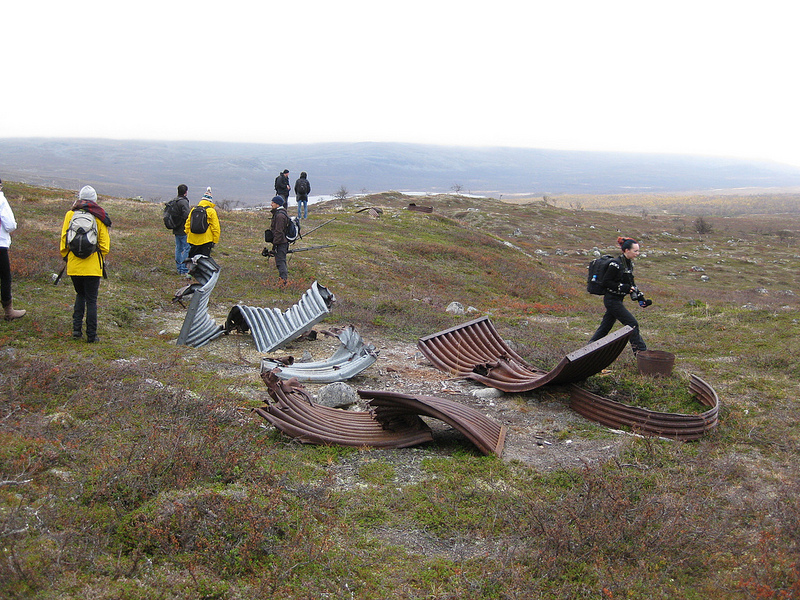 debris field It wasn’t long before we passed the tree line where the mountain birches gave way to an expanse of open tundra sweeping out before us in a swath of russet heath and exposed rock, with quivering patches of silver cloud here and there snagged on the crenellations of the topography. As if on cue, a small herd of reindeer appeared over the crest of a nearby hill and galloped across our field of view, cocking their heads as they past us and then just as quickly melting into the gloom of the opposite horizon. It is hard to judge distances here in this cold desert. An unusual rock formation in the distance might be small and quite close by or enormous and very far away.
I felt for a moment as if I had been transported back to the Pleistocene, as the landscape I was looking at was what much of Europe and North America would have been like at the end of the last Ice Age, though (other than the reindeer) there wasn’t any of the charismatic megafauna such as the woolly mammoth and the cave lions I would have had to concern myself with back then. Semi-domesticated, reindeer have sustained the local Sami people since ancient times and they are of the few creatures (other than snails) to manufacture the enzyme lichenase, enabling them to survive on lichen during the winter months.
How this delicate ecological balance will be affected by climate change is unclear but to my mind it doesn’t look good. Lichens exist in fairly specific temperature and humidity conditions and in Kilpisjärvi many are symbiotic with the birch trees, themselves a cold-dependent species. A continued warming trend in this region is bound to mean diminishment of suitable reindeer habitat. This has already occurred in North America, where the closely related Woodland Caribou has steadily disappeared from the southern portions of its range.
Standing in the middle of this iconic subarctic landscape, it is hard to imagine rapid changes occurring. For thousands of years, the processes shaping it have been gradual and incremental – the slow scouring of glaciers advancing and retreating, the infiltration of frost with its insidious heaving and splitting, the seasonal flows of meltwater into the lakes and rivers. The cold accentuates the sense of Deep Time here. Rocks dragged by ancient ice flows sit solemnly in place as if they stopped moving only yesterday. The sparse, slow growing vegetation is no match for the overwhelmingly geologic feeling of the place. Even minor disturbances stay visible for centuries.
But add even a small degree of warming and there would be potentially huge changes. Vegetative growth would ramp up, allowing trees to flourish in areas that were once windswept barrens. It is easy to imagine the slopes of Saana darkening as the Scotch Pine (Pinus sylvestris), now found only intermittently in the Kilpisjärvi area but quite common further south, finds conditions more suitable to it and becomes a dominant species. True tundra and the flora and fauna that depend on it could disappear from the area entirely.
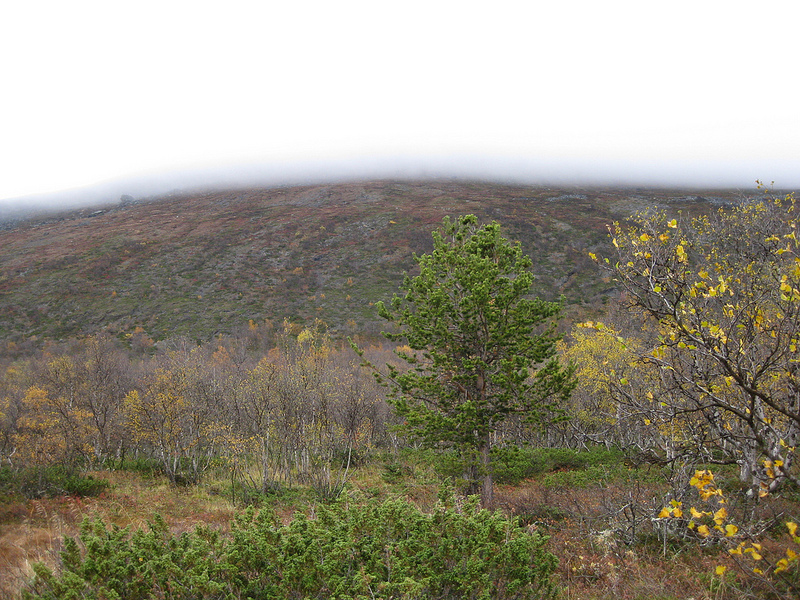 lone Scots pine Fast-forward a little further and there could be a whole host of new species that find the once frigid environs of Kilpisjärvi newly tolerable. A good many of these are likely to be weeds, which thrive on man-made disturbance. Investigating the grounds around the research station, I soon found a small clump of English plantain (Plantago major) a cosmopolitan weed, dubbed the ‘white man’s footprint’ by North American First Nations, who noticed it growing wherever European colonizers had disturbed the original ecosystem. The humble plantain is just the beginning. I predict that larger weed species will soon be gaining a foothold at Kilpisjärvi; their seeds imported on tire treads or blown in with the wind.
I wondered how it might look here when Ailanthus altissima, a tree variously known as the ‘Ghetto Palm’ or ‘Tree of Heaven,’ moves into the Finnish subarctic. Originally from China, Ailanthus is exuberantly invasive, and has already moved into ruderal (ruin) ecologies throughout the world without any signs of stopping. This tree has the astounding ability to feed off concrete, allowing it to thrive in cracks in pavement, the roofs and facades of under-maintained buildings and pretty much any other place its myriad seeds are able to lodge themselves long enough to germinate.
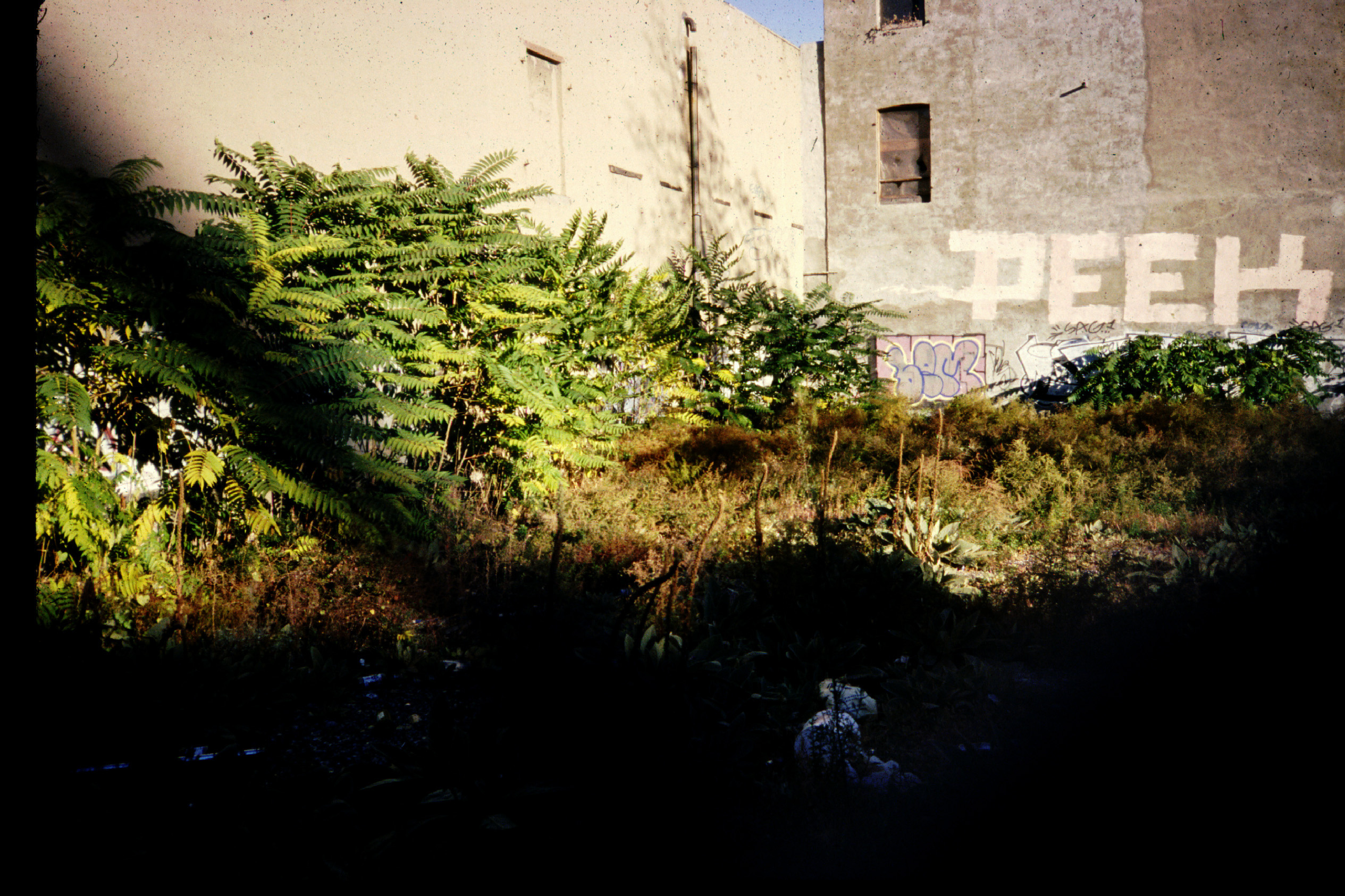 Ailanthus trees As the global south becomes uninhabitable due to increasing drought, wildfire and relentless heat, it isn’t hard to imagine a newly temperate Kilpisjärvi becoming a major magnet for climate refugees, human and non-human. Higher annual temperatures, as well as attracting different flora and fauna, could make the cultivation of cereal crops a possibility and perhaps other kinds of intensive agriculture, now more characteristic of Central Europe. This could transform the wild, transhumance landscape into a ‘Kulturlandschaft,’ the subarctic wilderness giving way to ploughed fields, perhaps even orchards. There might be a property boom as the open range lands once suitable only for reindeer husbandry become hosts to cash crops and housing estates. The effect on the traditional Sami lifestyle would be incalculable.
A climate-changed Kilpisjärvi would be a kind of ‘hyperecology’– a co-mingling of adaptive, cosmopolitan weeds, perhaps a few resilient local organisms and a steady in-migration of biota from the south. Outside the national parks and reserves, post-climate change nature will have even less of a free hand. There is massive industrial development afoot for Lapland, particularly mining and its ancillary industries which threaten to blight vast tracts of the relatively pristine landscape with open pit mines, tailings ponds and processing infrastructure, which, as well as inevitably introducing all sorts of pollution will create a new terrain vague of slag heaps and factory wastelands. These ‘brownfields,’ ubiquitous in much of the industrialized world are the preferred habitats of the globally distributed ragamuffin flora: Ailanthus, Buddlea and Robinia, which find the toxic and impoverished soils to their liking.
Industrialized, intensely cultivated and densely populated, the Kilpisjärvi of the not-to-distant future might look strangely familiar to any present day resident of a more temperate latitude. Yet what has been predictable there for so long will soon become much more extreme. We may all find ourselves moving north.
But climate change isn’t likely to stop at this arbitrary point. The heat will likely continue to build, especially if mankind continues dumping carbon into the atmosphere and particularly if the much feared ‘runaway greenhouse’ effect kicks in. What then for Kilpisjärvi? The Paleocene-Eocene Thermal Maximum that happened some 55 million years ago gives us a clue. In those days, the weather north of the Arctic circle was sultry and humid the year round. In addition to the Sciadopitys trees I described in my previous posting, vast swamp forests of Metasequoia and Taxodium spread out across the far north of Eurasia and North America, with turtles and crocodiles plying through the black water and mire. It would have resembled the bayou country of Louisiana or subtropical China, with snow and ice pretty much non-existent, a far cry from the frigid Kilpisjärvi of today, which can be icebound 200 days a year.
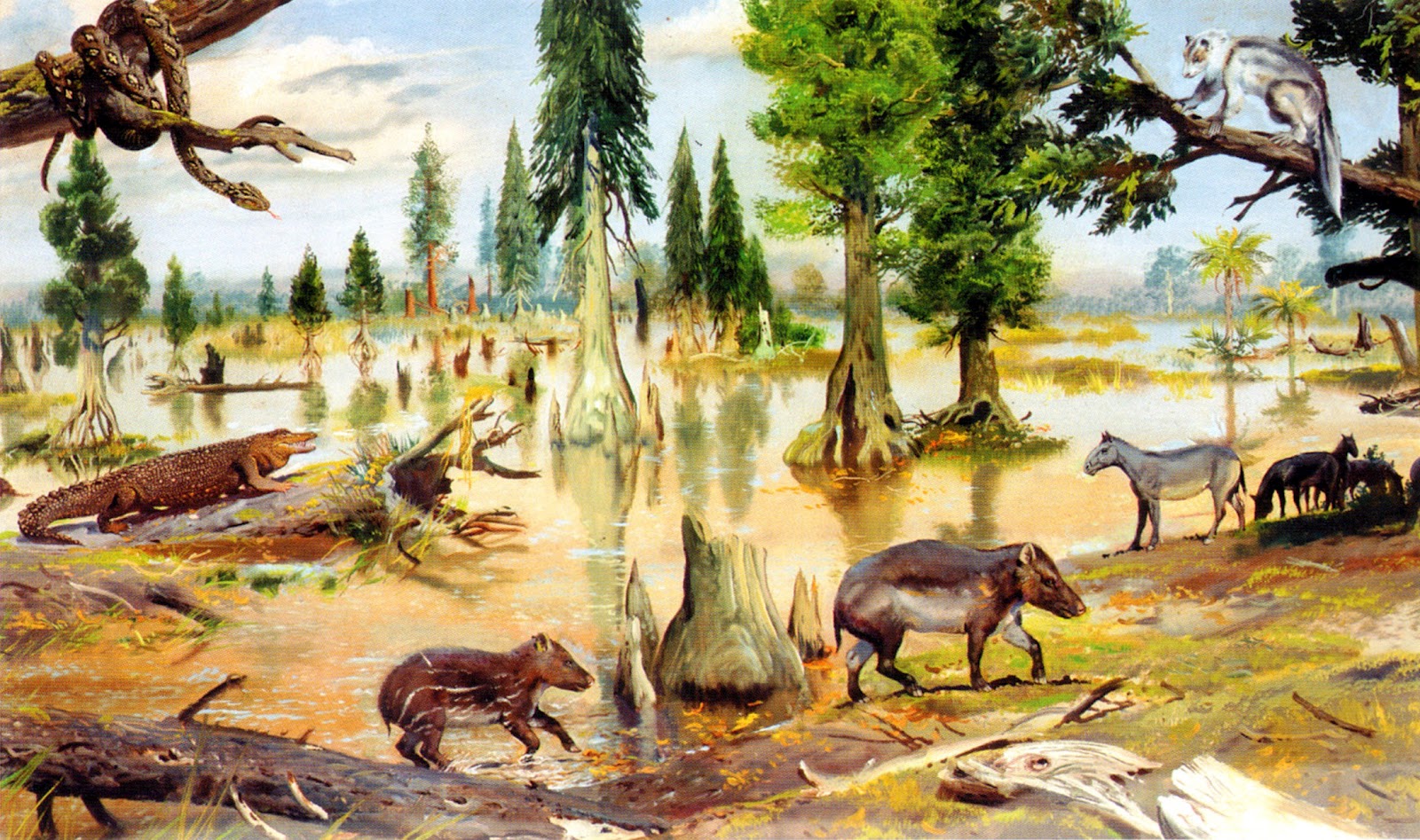 Eocene landscape Northern regions are well on track for a repeat of these subtropical conditions according to the most agreed upon climate change models, which predict an up to 4 degree Celsius rise globally by the end of the century, with a strong likelihood that changes in high latitudes will be more extreme. Though the biota will surely be more impoverished than it was in the Eocene, not having had anywhere near as much time to evolve, an anthropogenically tropical Lapland would be a mind-boggling yet disturbingly real possibility.
Though our species’ effect on climate can (and will) precipitate far-reaching changes in areas like Kilpisjärvi, there are many planetary processes playing out over which we have no control. The evolution of biota over Deep Time is as much happenstance as forward movement, with periods of great flourishing such as the infamous ‘Cambrian Explosion’ interspersed with ‘reversal’ or mass extinction, either organically or extraterrestrially engendered, which often obliterate whole classes of once dominant organisms and provide opportunities for minor ones to come out of the wings.
Past instigators of mass extinction have included: asteroid impacts, widespread volcanic eruptions with concomitant ocean acidification, even the evolution of photosynthesis by cyanobacteria, which released the toxic gas oxygen into the atmosphere to the detriment of the once dominant anaerobes. Any and all of these scenarios will likely play out again somewhere in the fullness of Deep Time, but barring the elimination of all life on the planet, it is worth speculating on the impact such upheavals would have on the vegetated landscape.
For example, what would happen if flowering plants, also known as angiosperms, dramatically declined, perhaps taken out by some pandemic or selective evolutionary pressure? They’ve really only been common since the Cretaceous and it isn’t hard to imagine Kilpisjärvi’s abundant so-called ‘lower’ plants – mosses, club mosses and liverworts, moving into the vacuum and attaining gigantic proportions, as was the case during in the coal swamps of the Carboniferous Period.
 Neo-Kilpisjärvi with giant club mosses A reduction in the availability of sunlight due to volcanic ash or widespread dust storms could have equally bizarre consequences. With green plants and algea in decline because of the challenge to photosynthesis, there would be a selective advantage for fungi, which might take over Kilpisjärvi forming bizarre, colossal structures as they did during the Devonian Period, some 400 million years ago, and again during the mayhem of the Permian mass extinction. Whether our own species would survive under such extreme and alien conditions is an open question, but life of some sort is almost certain to find a way. Perhaps fungi will regroup to form the planet’s supreme intelligence. Some would say, they already have!
It is this last point that gives me a vestige of hope. We Homo sapiens are a problematic creature, a classic, invasive species that thrives on disturbance, tends toward monoculture and displaces competing biota from its habitat. Yet in the overall scheme of things we are likely to be a transient phenomenon. We will either precipitate our own extinction, (and if the surviving ecosystems of the planet could sigh in relief, they surely would!), or we will find a way to live within our ecological means and develop a more equitable arrangement with the fellow denizens of the biosphere. My stay at the Kilpisjärvi Biological Station offered me the ideal vantage point to consider this conundrum. What we are in now is not so much of a ‘watershed’ moment but more of a ‘timeshed’ moment!
 Neo-Kilpisjärvi with giant fungi
|
|